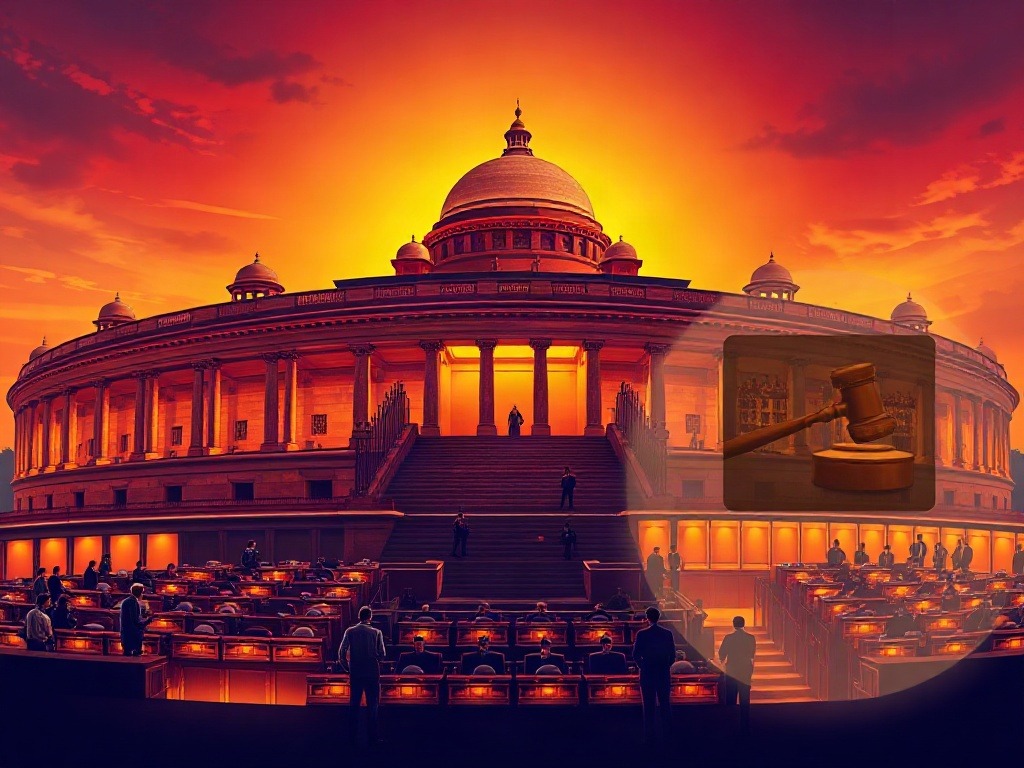
Introduction
Listen, I've been teaching this topic for over a decade now, and I can tell you something with absolute certainty: most students think Parliament is just a bunch of people shouting at each other on TV. And honestly? They're not entirely wrong! But there's so much more happening behind those mahogany desks than meets the eye.
The beautiful thing about understanding how Indian Parliament works is that it's not just exam preparation—it actually helps you become a better citizen. You start understanding how policies that affect your life actually take shape. Why does petrol price keep changing? How did that new education policy come into being? It all traces back to what happens in those chambers.
In this post, I'm going to walk you through Parliament like I do with my students over endless cups of chai. We'll talk about its structure, how bills become laws, the quirky rules that govern proceedings, and yes, I'll give you some memory tricks that actually work. So let's dive in, shall we?
Understanding Parliament: The Foundation
What Exactly Is Parliament?
Alright, let's start with basics. Parliament is India's supreme legislative body. Think of it as the factory where Indian laws are manufactured. But unlike a factory that produces just one product, Parliament produces hundreds of laws, policies, and decisions every year.
Now here's what surprises most students: Parliament isn't just about making laws. It has three main functions. Let me break them down for you:
Legislative function: Making new laws and amending existing ones. This is what people usually think of.
Executive function: Parliament controls the executive (the government). Ministers have to answer questions, pass budgets—they're basically answerable to Parliament.
Constituent function: Parliament can amend the Constitution itself (though with certain restrictions).
The Two Houses: Where They Differ
Here's something I tell every batch of students: Parliament has two houses, and they're not just different in size. They have fundamentally different purposes.
Lok Sabha is the Lower House, and it's directly elected by people. It has 545 members (530 from states, 13 from Union territories, and 2 nominated Anglo-Indians). The term is 5 years. Think of it as the "people's house"—more reactive to public opinion, more drama, more changes every election.
Rajya Sabha is the Upper House, more like the UK's House of Lords in concept. It has 245 members, and it's not directly elected. Instead, members are chosen by state assemblies or nominated by the President. It's more stable, more thoughtful, less subjected to electoral pressure. The term is 6 years, and one-third of members retire every 2 years.
Let me give you a trick I use with my students: Think of Lok Sabha as the Local/Live house (elected, direct, democratic pulse) and Rajya Sabha as the Reserve/Reflective house (stable, deliberative). That's all you need to remember the key difference.
The Journey of a Bill: From Idea to Law
Stage 1: Introduction (First Reading)
Here's where it all begins. A bill is introduced in either house (usually Lok Sabha for money bills). The member introducing the bill just gives notice. Think of it like announcing a cricket match—everyone knows it's happening, but no actual play has started. The bill is then published and circulated among members. This stage is purely procedural. The Speaker (in Lok Sabha) or Chairman (in Rajya Sabha) gives permission, and that's it.
Stage 2: Discussion and Amendment (Second Reading)
Now this is where things get interesting. The bill comes for detailed discussion. Members propose amendments, debate the principles behind it. This is usually where the real drama happens—questions are asked, concerns are raised, sometimes heated exchanges occur.
The bill can be sent to a Select Committee for deeper examination. These committees include members from both houses and they spend weeks studying the bill, hearing expert opinions, making recommendations. Then the bill comes back with suggested changes. You might be wondering—doesn't this slow things down? Yes, it does. But that's intentional. Important legislation needs scrutiny.
Stage 3: Passing (Third Reading)
After amendments are incorporated, the final bill is put to vote. Simple majority is required (more than 50% of members present and voting). If it passes, it moves to the other house and repeats the same process.
Now here's a crucial point: if both houses disagree on a bill, there's a procedure. The President can summon a joint sitting of both houses, where both houses sit together and vote. In a joint sitting, whoever has more members wins. That's why Lok Sabha, being larger, usually has more say.
Stage 4: Presidential Assent
After passing both houses, the bill goes to the President. The President can:
Give assent: Bill becomes law immediately.
Withhold assent: Bill dies (rare, but happens).
Return for reconsideration: President sends it back with suggestions. If Parliament passes it again, the President must give assent.
Let me clarify something crucial here: the President's role is ceremonial in most cases. The President represents the nation and follows the will of Parliament. It's not like in the USA where the President can veto and derail legislation. Our President is more like a constitutional guardian than a political player.
| Stage | What Happens | Duration |
|---|---|---|
| First Reading | Bill introduced and published | 1-2 days |
| Second Reading | Discussion, committee review, amendments | Weeks to months |
| Third Reading | Final vote in first house | 1-2 days |
| Other House | Repeats all three readings | Several weeks |
| Presidential Assent | President's approval | Few days |
The Day-to-Day Working of Parliament
Question Hour and Debate
One of the most important hours in Parliament is the first hour of every working day—Question Hour. This is where members ask ministers questions about their ministries' functioning. It's serious business despite looking chaotic on TV.
Questions are of four types. Let me give you a mnemonic that actually sticks: SUSI (sounds funny, but it works!):
S: Starred questions (member wants an oral answer, wants supplementary questions allowed)
U: Unstarred questions (written answer preferred)
S: Short notice questions (asked with short notice)
I: Impeachment questions (questions about minister's conduct)
After Question Hour comes Zero Hour (at 12 noon). This is when members can raise urgent matters of public importance. No prior notice needed. This is where you see MPs passionately talking about local issues—damaged roads, school closures, water shortage in their constituency.
Parliamentary Conduct and Business
Parliament has a Speaker (in Lok Sabha) and a Chairman (in Rajya Sabha). These aren't neutral moderators like you'd think. The Speaker is actually elected, usually from the ruling party. But here's the interesting part—once elected, there's an unwritten understanding that the Speaker becomes impartial. It's called "Speaker's neutrality," and it mostly holds.
The Speaker maintains order, rules on points of order, decides which bills to take up when. The Speaker can suspend members, disqualify them from voting, adjourned sessions—basically, the Speaker is the ultimate authority in the chamber.
Now, you must have seen on news that Parliament sometimes adjourns or suspends sessions. When does this happen? When order breaks down too much, when there's loud shouting or disruption, the Speaker can suspend proceedings. Sometimes entire sittings are adjourned. This happened a lot during the 2020-21 sessions when farmer protests were happening outside Parliament.
Voting and Passing Bills
When it comes time to vote, members vote using electronic machines (though voice votes and divisions still happen for some matters). A simple majority is required for most bills. That means more than half of those present and voting need to vote in favor.
But wait—there's something important about Constitutional amendment bills. These require a special majority: at least 2/3rd of those present and voting, and at least half of the total strength of the house. This is an extra safeguard to prevent the ruling party from casually amending the Constitution.
Special Powers and Parliamentary Committees
One of the most underrated aspects of Parliament is its committee system. There are standing committees, select committees, and special committees. Each has members from both houses and specific roles.
For example, the Public Accounts Committee (PAC) examines government spending and accounts. The Committee on Estimates examines government expenditure forecasts. These committees do serious investigative work that often doesn't make headlines but affects policy significantly.
Here's something most students don't know: Parliamentary committees have power to summon people, demand documents, and even punish non-compliance. A minister or bureaucrat cannot simply refuse to appear before a committee. This is how Parliament maintains oversight over the executive.
I'll give you one more important concept—Privilege of Parliament. Members have immunity for things they say in Parliament. A member cannot be sued or prosecuted for statements made in the chamber. This protects free speech within Parliament. But this protection doesn't extend to outside Parliament. This is why you see members sometimes making outrageous statements in Parliament—they're legally protected there.
Common Misconceptions and Final Thoughts
Before I wrap up, let me address something I see all the time in exams—students confusing President's powers with Prime Minister's powers in the legislative process. The PM is an MP (usually from Lok Sabha) and is the head of government, but the President is the constitutional head. In legislative matters, the President's role is largely ceremonial. The real legislative power lies with Parliament.
Another thing: Lok Sabha supremacy. Our Constitution gives Lok Sabha supremacy over Rajya Sabha in most matters. Money bills are decided entirely by Lok Sabha. In joint sittings, numbers matter, and Lok Sabha wins. This is intentional—the directly elected house should have more power. But it doesn't mean Rajya Sabha is powerless. It can delay bills (except money bills), send them back for reconsideration, and investigate thoroughly through committees.
Understanding Parliament isn't just about memorizing dates and processes. It's about understanding how a democratic system balances power, ensures accountability, and tries to make decisions that benefit 1.4 billion people. Is it perfect? Far from it. But it's a living, functioning democracy, and that's genuinely remarkable.
For your exams, remember this isn't just about rote learning. Understand the philosophy behind each step. Why does a bill need three readings? Because it ensures scrutiny. Why two houses? Because different bodies have different roles and can check each other. When you understand the "why," the "what" automatically sticks.
Now, let me give you some practice questions. These are the kinds of questions you'll actually face in SSC CGL or UPSC, so take your time with them.
A) Money Bills can be introduced in either Lok Sabha or Rajya Sabha B) Rajya Sabha has 14 days to give recommendations on Money Bills C) Money Bills require a 2/3rd majority to pass D) Money Bills cannot be amended
Answer: B) Rajya Sabha has 14 days to give recommendations on Money Bills. Money Bills are bills related to revenue and expenditure, and they can only be introduced in Lok Sabha. The Rajya Sabha gets only 14 days to recommend changes (not reject), and if it doesn't respond within 14 days, the bill is deemed passed.
A) 4 years B) 5 years C) 6 years D) 7 years
Answer: C) 6 years. Rajya Sabha members have a 6-year term, and one-third of them retire every 2 years. This ensures continuity and stability in the Upper House, unlike Lok Sabha where all members' terms end together.
A) Prime Minister B) Vice President C) Speaker D) Deputy Speaker
Answer: B) Vice President. The Vice President of India serves as the Chairman of Rajya Sabha. This is the only constitutional role given to the Vice President. In contrast, the Lok Sabha Speaker is elected by members of Lok Sabha.
A) The bill is rejected automatically B) The President decides C) A joint sitting is convened D) The bill is sent back to the committee
Answer: C) A joint sitting is convened. When there's a disagreement between the two houses on a bill (except money bills), the President can summon a joint sitting. Both houses meet together, and voting happens. Lok Sabha, being larger, typically has more voting power in joint sittings.
A) A one-hour session where members can ask questions about government functioning B) A session where opposition members criticize the government C) A period for private member bills D) A ceremonial opening of Parliament
Answer: A) A one-hour session where members can ask questions about government functioning. Question Hour occurs at the beginning of each parliamentary working day. Members ask ministers questions (starred, unstarred, or short notice), and ministers must provide answers. It's one of the most important mechanisms of parliamentary accountability.
Published by Dattatray Dagale • 10 October 2026









0 Comments