Introduction
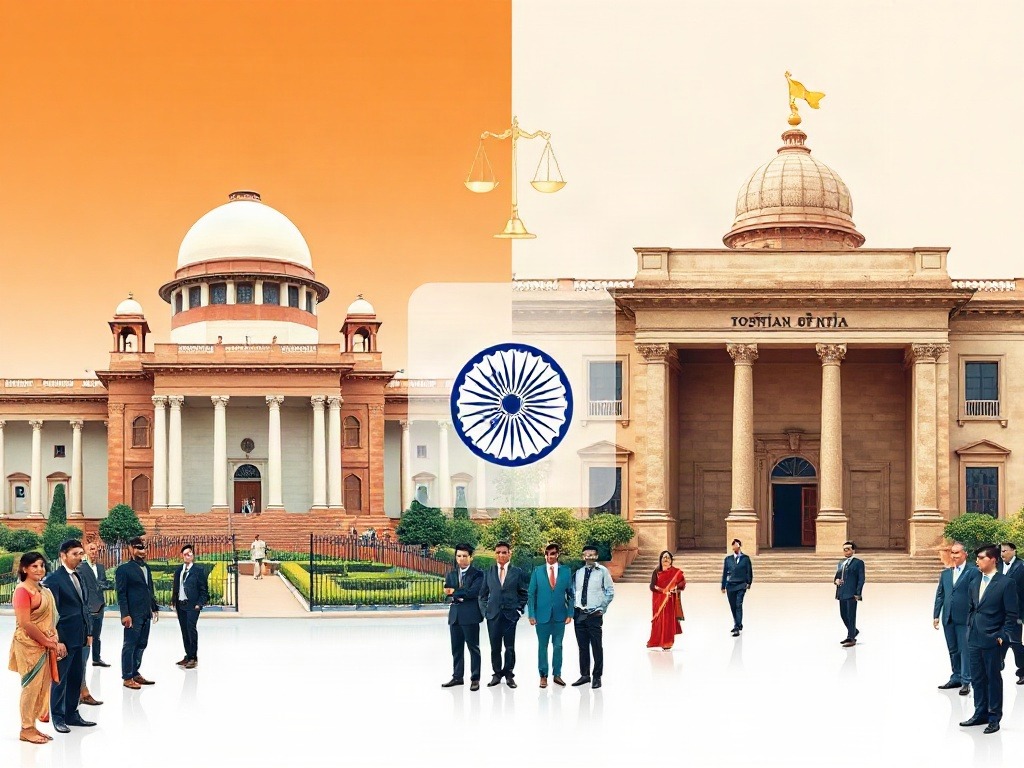
Let me start with a confession: when I first started teaching Indian Polity about a decade ago, I made the same mistake many of my students still make. I'd see "President" and "Governor" and think, "Okay, same role, different levels—National vs State." Wrong.
The relationship between these two constitutional positions is far more nuanced and, honestly, far more fascinating than it initially appears. And here's what makes it crucial for your exam: questions about Presidential vs Gubernatorial powers appear in almost every single SSC CGL, UPSC Prelims, and state-level exam. But most students get them wrong because they confuse the theoretical framework with the practical reality.
So let's break this down together, the way I'd explain it if you were sitting across from me with a cup of chai.
The President: India's Constitutional Head of State
Who Is the President, Really?
Here's something that trips up a lot of aspirants: the President of India is not the Prime Minister. I can't stress this enough. The President is the Head of State—a ceremonial and constitutional figurehead. The Prime Minister is the Head of Government—the one with actual executive power.
Think of it like this: if India were a cricket team, the President would be like the team's patron or honorary captain—all the glory, all the formality, all the respect. But the actual captain on the field, making tactical decisions and leading the play? That's the PM.
The President is elected indirectly by an Electoral College consisting of elected members of the Lok Sabha, Rajya Sabha, and State Legislative Assemblies. Not by popular vote. This was a deliberate choice by Dr. Ambedkar and the Drafting Committee—they wanted the President to be above politics, a unifying figure for the entire nation.
Powers of the President: Theory vs Reality
Now here's where it gets interesting. On paper, the President has enormous powers. The Constitution lists them out beautifully—executive powers, legislative powers, judicial powers, emergency powers. Read Article 53 onwards, and you'd think the President is basically a benevolent monarch.
But here's the trick that every exam asks about: almost all of these powers are exercised "on the advice of the Council of Ministers headed by the Prime Minister." This phrase, tucked away in Article 74, is the constitutional skeleton key that explains the entire Indian executive structure.
In other words: the President acts. The Prime Minister decides.
Let me give you a practical example. When the President signs a bill into law, making it an Act, the President doesn't actually read it and decide whether to sign or not (usually). The Cabinet has already decided. The PM has recommended it. The President's signature is the formal, constitutional stamp. It's powerful in its symbolism but limited in its discretion.
The Governor: The President's Representative in the States
The Constitutional Position of the Governor
Here's something that often confuses students: the Governor is not elected. The Governor is appointed by the President on the advice of the Prime Minister (and increasingly, with input from state governments, though this remains contested).
This is actually a legacy of the British Raj—the idea that the Center needs a representative in every state. In the original Constitution, this made sense. The states were not seen as equals to the Center; they were seen as administrative units of a centralized union. The Governor was literally the President's representative.
Over the decades, especially after the State Reorganization Act of 1956, this relationship has evolved. But the basic structure remains: Governor is appointed by the President, and in theory, serves at the President's pleasure. This means a Governor can be removed without needing a formal trial or impeachment.
Powers of the Governor and the Discretionary vs Non-Discretionary Distinction
Now, this is where many students get confused, and I see it constantly in mock exams. The Governor's powers are similar to the President's—executive, legislative, and some quasi-judicial powers. But here's the critical distinction:
Some of the Governor's powers are discretionary.
What does "discretionary" mean? It means the Governor can exercise these powers based on her own judgment, not necessarily on the advice of the Council of Ministers of the state. This is dramatically different from the President, where almost everything is non-discretionary (i.e., requires ministerial advice).
Let me give you a mnemonic I teach all my students. I call it the "RIDER" mnemonic for Governor's discretionary powers:
R – Reservation of bills for Presidential assent
I – Imposition of President's Rule (in case of political crisis)
D – Dissolution of the state assembly (in certain situations)
E – Exercising judgment in appointing ministers (who to invite to form government)
R – Reports to the President (especially on constitutional matters)
These are areas where the Governor doesn't necessarily have to follow the Chief Minister's advice. For example, if a government loses its majority in the state assembly, the Governor can use discretion in deciding whether to dissolve the assembly, call for fresh elections, or allow another coalition to form government.
The President, by contrast, has almost no such discretionary powers—the PM's advice is binding in nearly all cases.
Key Differences: A Comparative Analysis
| Aspect | President | Governor |
|---|---|---|
| Selection | Elected by Electoral College (MPs, MLAs) | Appointed by President on PM's advice |
| Level | National/Union | State |
| Term | 5 years (eligible for re-election) | 5 years (but removable at will) |
| Discretionary Powers | Very limited (almost everything requires PM's advice) | Significant (RIDER powers) |
| Who gives advice? | Council of Ministers headed by PM | Council of Ministers headed by CM (usually) |
| Can refuse advice? | Theoretically yes, but practically never. Bound by Article 74 | Yes, in discretionary matters |
| Removal | Impeachment (Article 61) - Very difficult | Removal by President at will (Article 156) |
The Powers in Detail: What They Can Actually Do
Executive Powers
Both the President and Governor have executive powers. They appoint judges, officers, ambassadors (President only), and various constitutional bodies. But remember: the President acts on PM's advice, the Governor can act with more independence in certain matters.
A Governor can reserve a bill for the President's consideration—meaning she's saying, "This bill is constitutionally important or controversial. I want the President to look at it before it becomes law." This is a discretionary power. The CM can't force the Governor to simply sign it.
Legislative Powers
The President can't directly pass laws—that's Parliament's job. But the President can:
• Summon, prorogue, and dissolve the Lok Sabha and Rajya Sabha
• Give assent to bills (without which they don't become Acts)
• Address Parliament
• Issue ordinances when Parliament is not in session
Similarly, the Governor can summon, prorogue, and dissolve the state assembly, give assent to bills, and issue ordinances.
Here's a nuance: an ordinance by the President or Governor is a temporary law that lasts six weeks after Parliament/Assembly reassembles, unless it's replaced by a proper bill. It's meant for emergencies. During COVID-19, for instance, governments issued many ordinances. This power is massive—it's why it matters who advises the President or Governor on ordinances.
Emergency Powers
The President has powers to declare three types of emergencies: National Emergency (Article 352), President's Rule in states (Article 356), and Financial Emergency (Article 360). These are among the most powerful constitutional provisions in India. A National Emergency, once declared, can suspend the fundamental rights of every citizen. Scary stuff.
The Governor, by contrast, doesn't have emergency powers to declare. But the Governor does have the power to recommend President's Rule in the state—which is a different kind of power (more on this in a moment).
A Real-World Scenario: When Theory Meets Practice
Let me tell you a story that brings all this together. A few years ago, I had a student, Priya, who couldn't understand why the President sometimes seems so powerful but in reality does very little. So I gave her a scenario:
"Imagine the PM and President disagree on a bill," I said. "The bill is controversial. The PM wants it signed. The President doesn't like it. What happens?"
Priya thought for a moment. "The President refuses to sign it?"
"Good thought," I said. "But no. The President can technically hold the bill for consultation, but eventually, the pressure of ministerial advice becomes binding. The President must sign. This has never happened in India—a President refusing to sign. Because the system is designed so that it shouldn't happen."
"Now," I continued, "imagine a state is in political chaos. The ruling coalition collapsed. Multiple parties claim to have the numbers to form government. The Chief Minister says one thing, the Governor thinks another. Who decides?"
"The Governor?" Priya ventured.
"Exactly! Here, the Governor has discretion. The Governor can invite the party she believes has the majority to form government. Or she can recommend dissolving the assembly. Or President's Rule. This is real power."
That's the difference. The President is powerful on paper but bound by convention. The Governor is less powerful on paper but can wield real discretion in practice.
Common Misconceptions (That Trip Up Even Smart Students)
Misconception 1: "The President is above the Governor, so the President has more power."
Reality: The President has a higher constitutional position, but that doesn't mean more discretionary power. In fact, in specific situations, the Governor has more freedom to act.
Misconception 2: "If the PM advises the President, the President must follow it."
Reality: The Constitution says the President acts on "the advice" of the Council of Ministers. In theory, there's a tiny space for refusal. In practice, this space doesn't exist—the advice is binding. But constitutionally, it's advice, not an order.
Misconception 3: "Governors are just representatives of the state in Delhi."
Reality: Governors are appointees of the Center, but they're constitutional functionaries with genuine powers in the state government. Recent controversies have highlighted how a Governor aligned with the Center can block state government decisions—which is why Governor-CM relations have become quite politically charged in India.
Quick Tips for Exam Success
I always tell my students: when you see a question about President or Governor powers, first ask yourself: Is this a discretionary power or non-discretionary power?
If it's about the President doing something without the PM's advice, suspect it's a trick question. The President almost never acts independently.
If it's about the Governor acting independently—especially around President's Rule, dissolution, or government formation—that's a real Governor power.
Also, remember: the Constitution defines powers, but the Constitution is also silent on many things. Much of what President and Governor do is based on convention—unwritten customs that have grown over decades. This is why Indian constitutionalism is alive and evolving. Questions about Governor's discretion, President's emergency powers, etc., are favorite areas for UPSC precisely because the law here is contested and evolving.
One more thing: I've given you the RIDER mnemonic for Governor's discretionary powers. Let me give you another one for President's non-discretionary powers. I call it "PM CALLS":
P – Parliamentary functions (all need PM's advice)
M – Ministers appointed on PM's advice
C – Cabinet decisions binding on President
A – Appointments of officials on PM's advice
L – Legislative assent (bills) on PM's advice
L – Laws (ordinances) on PM's advice
S – Suspensions (emergencies) theoretically discretionary but practically on PM's advice
Use these mnemonics, and you'll remember the key differences forever.
Practice Questions
A) Signing state bills into law on the advice of the Chief Minister
B) Recommending dissolution of the State Legislative Assembly in case of political deadlock
C) Implementing policies decided by the state cabinet
D) Appointing judges of the High Court on the advice of the CM
Answer: B) Recommending dissolution of the State Legislative Assembly in case of political deadlock. This is a classic discretionary power where the Governor can act based on her judgment of the constitutional crisis.
A) Because the President has supreme executive power
B) Theoretically, under the Constitution, the President can refuse, but in practice, the PM's advice is binding
C) The President can never refuse; the Constitution mandates signing
D) Only if the bill violates fundamental rights
Answer: B) Theoretically, under the Constitution, the President can refuse, but in practice, the PM's advice is binding. Article 74 makes ministerial advice binding. The President acts on advice, but the advice itself is binding.
A) The Governor alone can declare President's Rule
B) The President declares President's Rule on the recommendation of the Governor and advice of the Cabinet
C) The Prime Minister declares President's Rule with the President's consent
D) The Chief Minister can request President's Rule
Answer: B) The President declares President's Rule on the recommendation of the Governor and advice of the Cabinet. The Governor's recommendation is crucial, but the President, on Cabinet advice, actually makes the declaration.
A) The President and PM have equal powers, divided between head of state and government
B) The President is the supreme executive authority; the PM merely advises
C) The President acts as a constitutional figurehead in executive matters, with real power vested in the PM
D) The PM is subordinate to the President and acts only on the President's orders
Answer: C) The President acts as a constitutional figurehead in executive matters, with real power vested in the PM. This reflects the Westminster system's evolution in India where the President has become predominantly ceremonial.
A) By impeachment by the State Legislative Assembly
B) By a vote of no-confidence in the state assembly
C) By the President at will, since the Governor is appointed by the President
D) By the Supreme Court if the Governor violates the Constitution
Answer: C) By the President at will, since the Governor is appointed by the President. Article 156 allows the President to remove a Governor. Contrast this with the President, who can only be removed by impeachment, making removal far more difficult.
Published by Dattatray Dagale • 16 September 2026
.jpg)
.png)


.png)



.png)

0 Comments