Introduction
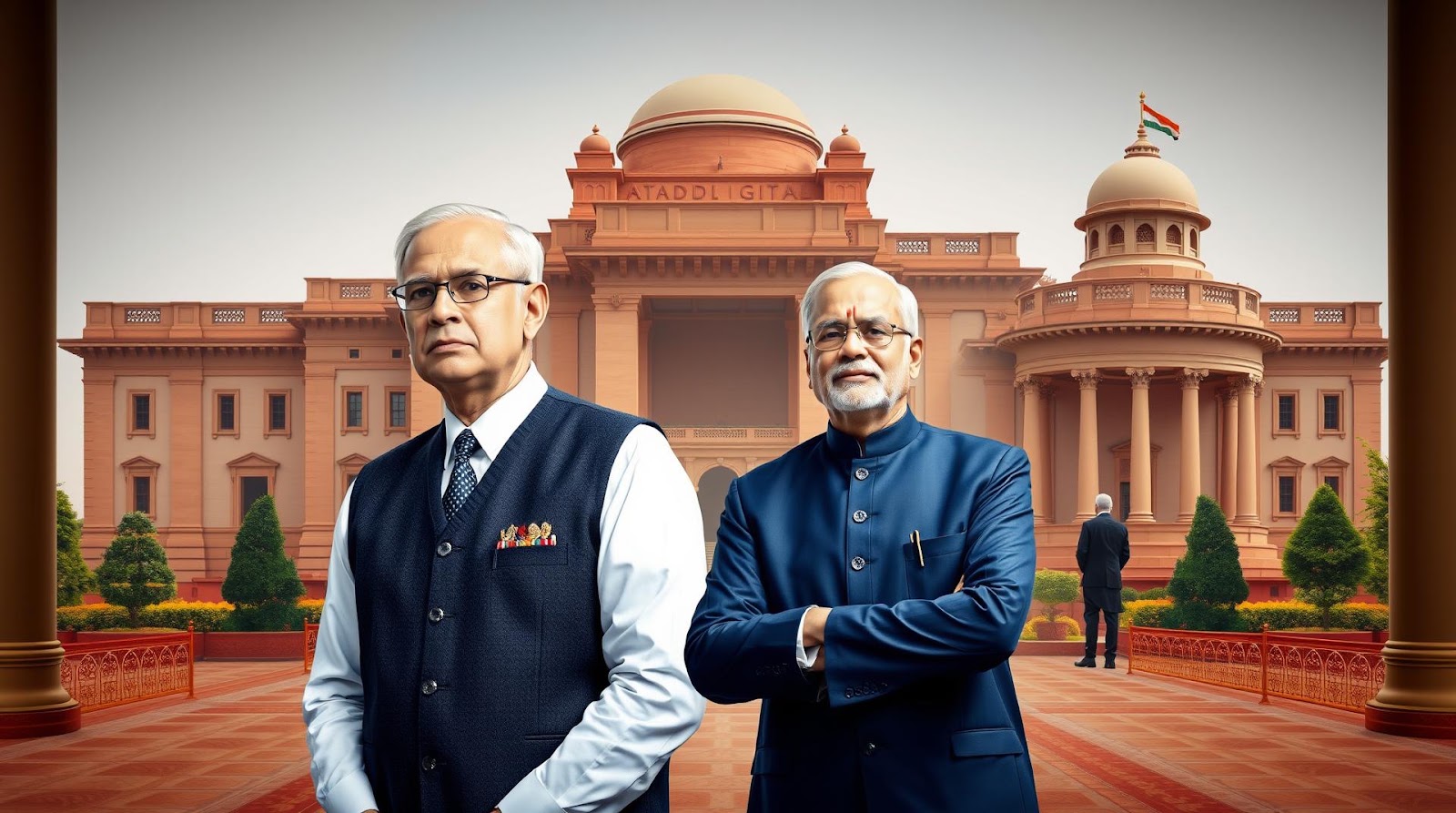
Let me start with a question I've asked thousands of students over the years: "Who has more power — the President of India or a Governor?" Nine out of ten times, I get the same confident answer: "The President, obviously!" And you know what? Most of them are partially right, but it's way more nuanced than that.
I remember once, during a particularly chatty class, a bright student asked me: "Sir, if the President is the head of India, why do we never hear about them making decisions? Meanwhile, the Chief Minister seems to run the entire state." That one question stuck with me because it perfectly captures the confusion students have about our parliamentary system.
Here's the truth — and this is crucial — India's President and Governors are constitutional heads, not executive heads. The real power sits elsewhere. But that doesn't mean they're powerless. Not even close. In this post, we're going to unpick this beautifully complex system that Ambedkar and our founding fathers built, and I promise by the end, you'll see how it all fits together like a perfectly planned cricket strategy.
The President: India's Constitutional Figurehead With Silent Strength
Who Elects the President and What's the Timeline?
The President of India is elected by an Electoral College — not by direct popular vote. This Electoral College consists of:
• All Members of Parliament (both Lok Sabha and Rajya Sabha)
• All Members of State Legislative Assemblies
• (Notably, NOT Nominated members, only elected ones count)
Now here's where it gets interesting — the voting system uses weighted voting. Every MP's vote carries more weight than a state MLA's vote because Parliament is national, while assemblies are local. The President serves a 5-year term and can be re-elected (unlike the PM who is limited theoretically by convention after two consecutive terms).
A fun mnemonic I tell my students: PEP-5: President elected by Electoral college, Parliament + state assemblies, 5 years term.
Presidential Powers: Where the Real Authority Lies
Here's where most students get confused. The President has enormous powers on paper — but these are exercised "on the advice of the Cabinet" (Article 74). This is the magic clause that makes our system work.
The President can:
• Appoint the Prime Minister (but only the leader who commands the confidence of Lok Sabha)
• Dissolve the Lok Sabha (on PM's advice)
• Give assent to bills (without which they don't become law)
• Declare national emergency under Article 352 (external threat), 356 (state emergency), or 360 (financial emergency)
• Grant pardons, reprieves, and commutations
• Be the Commander-in-Chief of armed forces (ceremonially, though)
• Summon/prorogue Parliament
But — and this is a massive "but" — the President cannot refuse any of this on their own whim. The Cabinet must advise, and the President must act on that advice (with rare constitutional exceptions). It's like being a king who must listen to their advisors on everything important.
When Does the President Actually Matter?
Now you might be thinking: "Sir, if the President just rubber-stamps everything, why study them?" Brilliant question! The President matters tremendously when:
1. No Clear Majority Exists: When election results are fractured (like we've seen multiple times), the President has discretion in inviting someone to form government. Dr. Manmohan Singh's appointment in 2004 was the President's call — Sonia Gandhi refused PM position, and the President picked Singh. Game-changing moment.
2. Constitutional Crises: The 1975 Emergency declared by President Fakhruddin Ali Ahmed under Article 352 based on PM Indira Gandhi's advice shaped our nation's trajectory. The President's signature made it constitutionally valid.
3. Pardons and Clemency: Presidents have exercised mercy powers independently. Remember the Nirbhaya case? The President's power to commute death sentences is a real, substantive power.
4. The Pocket Veto: While rare, a President can theoretically delay assent to a bill (not explicitly refuse, but delay indefinitely — though convention strongly discourages this).
Governors: The Mini-Presidents of States
Appointment and Tenure — The Political Nature of the Role
Governors are appointed by the President on the advice of the Central Government — and here's where things get politically spicy. Unlike the President who has some institutional distance, Governors are essentially representatives of the Central Government in states. This has been a source of tremendous conflict, especially when different parties rule at the Centre and in states.
A Governor serves a term of 5 years, but can be removed by the President "at pleasure" (Article 156). This means theoretically, if the Centre doesn't like the Governor's actions, they can remove them anytime. In practice, this power is exercised rarely, but the threat of it is always there.
Gubernatorial Powers: Executive and Legislative
Governors have powers strikingly similar to the President, but at the state level:
Executive Powers:
• Appoint the Chief Minister (though must choose whoever commands the majority in Assembly)
• Appoint state cabinet ministers, judges, and other officials
• Is Commander-in-Chief of state armed forces (ceremonial)
• Superintend and direct state administration
Legislative Powers:
• Summon, prorogue, and dissolve state assembly
• Give assent to bills (no bill becomes law without this)
• Address the state legislature at the start of the session
• Appoint nominated members to the assembly (if applicable)
• Issue ordinances when the assembly is not in session
Judicial Powers:
• Grant pardons, reprieves, remissions, and commutations of sentences
• Suspend or remit sentences (subject to central government rules)
The critical thing to remember: Like the President, the Governor acts on the advice of the state Cabinet. Article 163 says the Governor shall be guided by the advice of the Chief Minister in matters of executive business. So the CM is to the Governor what the PM is to the President — the real power.
The Controversial Role — When Governors Become Political Players
Here's where my teacher's heart gets heavy. Governors, in practice, have often been accused of overstepping their constitutional boundaries. I've seen cases where:
• Governors dissolved state assemblies seemingly on whims or political considerations
• Delayed signing bills passed by state legislatures to influence state politics
• Used their power to invite formation of government to favor a particular party
• Issued ordinances to bypass legislative processes
The 2020 case of the Maharashtra Governor is a perfect example — the discretion in inviting which party leader to form government became intensely political. The Supreme Court had to step in multiple times. These moments show that while Governors have constitutional limits, the interpretation and exercise of these powers can be highly political.
President vs Governor: A Direct Comparison
| Aspect | President | Governor |
|---|---|---|
| Scope | National/Union level | State level |
| Elected By | Electoral College (MPs + MLAs) | Appointed by President (on Central Govt. advice) |
| Term | 5 years, re-eligible | 5 years, at pleasure of President |
| Removal | Impeachment by Parliament | At the pleasure of President |
| Acts On Advice Of | Union Cabinet/PM | State Cabinet/CM |
| Appoints | PM, judges, constitutional posts | CM, state ministers, judges |
| Key Emergency Power | Declare national emergency (Art. 352) | Declare state emergency (Art. 356) |
The Big Picture: Why This Design Matters
Before we wrap up, let me give you the bigger philosophical picture. When Ambedkar drafted our Constitution, he created a system where the head of state (President/Governor) and head of government (PM/CM) are separated. This is a Westminster influence.
The genius is this: The President/Governor provides constitutional continuity and ceremonial leadership (important symbolically for national unity), while the PM/CM provides actual executive power and accountability. The PM can be voted out by Parliament; the President cannot. The PM changes with governments; the President remains a stabilizing force.
It's like having a monarch (though elected and not hereditary) and a prime minister. The President reigns; the PM governs. Both are necessary.
When things go wrong — when political instability threatens democracy — the President becomes the guardian. When a government acts unconstitutionally, the President's assent can be withheld (though this happens rarely and controversially). The President is our constitutional safety valve.
For Governors, the system is trickier because they're appointed by the Centre rather than elected. This has always been contested — many argue Governors should be elected by state assemblies to reduce central interference. But that's a different debate for another day.
Quick Tips for Your Exam
Key Articles to Remember:
• Article 52-62: President
• Article 153-167: Governors
• Article 74 & 163: The "advice" clause that limits their power
• Article 352, 356, 360: Emergency powers
Common Mistake Students Make: They confuse President's powers with PM's powers. Remember — President has powers on paper. PM executes policy in reality. For exams, unless specifically asked about ceremonial or emergency situations, think PM, not President.
For Governor Questions: Always remember they're appointed, not elected. This is politically sensitive. Recent years have seen more questions about Governor's discretion in government formation. Read recent news to understand how this plays out practically.
---Practice Questions
A) All members of Parliament only B) MPs, Rajya Sabha members, and nominated members of state assemblies C) Elected members of Parliament and elected members of state assemblies D) Only state Chief Ministers and Union Ministers
Answer: C) Elected members of Parliament and elected members of state assemblies. Nominated members don't have voting rights in presidential elections.
A) Article 52 B) Article 74 C) Article 153 D) Article 256
Answer: B) Article 74. This is the crucial clause that makes the President's position ceremonial while real power lies with the PM.
A) Only through impeachment by the state legislature B) At the pleasure of the President C) Only after completing a 5-year term D) With the consent of the Chief Minister
Answer: B) At the pleasure of the President. This is a key difference from the President who can only be removed through impeachment.
A) Article 352 B) Article 356 C) Article 360 D) Article 368
Answer: B) Article 356. This allows the President (on Governor's report or on other grounds) to declare President's rule in a state.
A) True, there's no constitutional limit B) False, Presidents cannot serve more than one term C) True, but only with special parliamentary approval D) False, only one re-election is allowed
Answer: A) True, there's no constitutional limit. Presidents can serve multiple 5-year terms. This is different from many other democracies and differs from PM convention.
Published by Dattatray Dagale • 19 April 2026
.jpg)
.png)



.png)



.png)
0 Comments