Introduction
You know, when I first started teaching, I realized that most students saw the Mughal Empire as just a bunch of names and dates to memorize. Akbar, Aurangzeb, Shah Jahan—they'd rattle them off like a shopping list without understanding what made these rulers tick. But here's what changed everything for me: the day I started asking my students, "Have you eaten at a Mughlai restaurant? Have you seen the Taj Mahal? Do you know why Indian food has so much Mughal influence?"
Suddenly, the Mughal Empire wasn't ancient history anymore. It was alive in their everyday life. That's what I want to do for you today.
The Mughal Empire (1526–1857) wasn't just another dynasty that ruled India. It was a transformative force that reshaped our culture, cuisine, administration, art, and architecture in ways we're still living with today. When you eat biryani, when you see Persian calligraphy, when you walk into a building with Islamic arches—that's Mughal legacy, my friend.
For your SSC CGL and UPSC exams, understanding the Mughal period isn't about cramming facts. It's about understanding how empires work, how cultures blend, and how history shapes a nation. And I promise you, once you see the connections, you'll never forget it.
From Babur to the Glory Years: How It All Began
Who Was Babur, Really?
Let me start with a fun fact: Babur was actually a reject from Central Asia. Seriously! This man was fighting for his grandfather's kingdom in Afghanistan, got defeated multiple times, and then thought, "You know what? Let me go conquer India instead." And he did. In 1526, at the Battle of Panipat (yes, the same Panipat where multiple historic battles happened—it's like the Wankhede Stadium of medieval warfare), Babur defeated Ibrahim Lodhi's Delhi Sultanate.
Now, here's the thing I tell my students: Babur didn't come to establish a dynasty. He came as a military adventurer. But his grandson? His grandson had other plans.
Akbar: The Empire's Real Architect
If Babur was the founder, Akbar (ruled 1556–1605) was the genius who actually built something that would last. And when I say genius, I mean it—this man was illiterate. Yes, you read that right. The greatest administrative mind of the Mughal Empire couldn't read or write formally. But he could listen. He could observe. He could think.
Akbar did three things that changed everything:
First, he built an administration that actually worked. He created a centralized system with provincial governors (subahs), introduced the Mansabdari system (a military ranking and salary structure based on merit, not just nobility), and made bureaucracy efficient. This is why you see questions about Akbar's administration in every competitive exam.
Second, he was pragmatic about religion. Instead of forcing Islam on everyone (which would've caused constant rebellion), Akbar abolished the Jizya tax on non-Muslims, appointed Hindus to high positions, and even married Rajput princesses. His motto was essentially: "Rule through acceptance, not coercion." This policy of sulh-i-kul (universal peace) became the backbone of Mughal governance.
Third, he understood that empires need culture, not just swords. He built Fatehpur Sikri, patronized the arts, and created a cosmopolitan court where poets, artists, and philosophers from across the world converged.
The Golden Age: Art, Culture, and the Taj Mahal
When Art and Power Met
You want to know what really fascinates me about the later Mughal emperors? They understood that power isn't just about armies. It's about legacy. It's about what people remember a thousand years later. Shah Jahan (ruled 1628–1658) understood this perfectly.
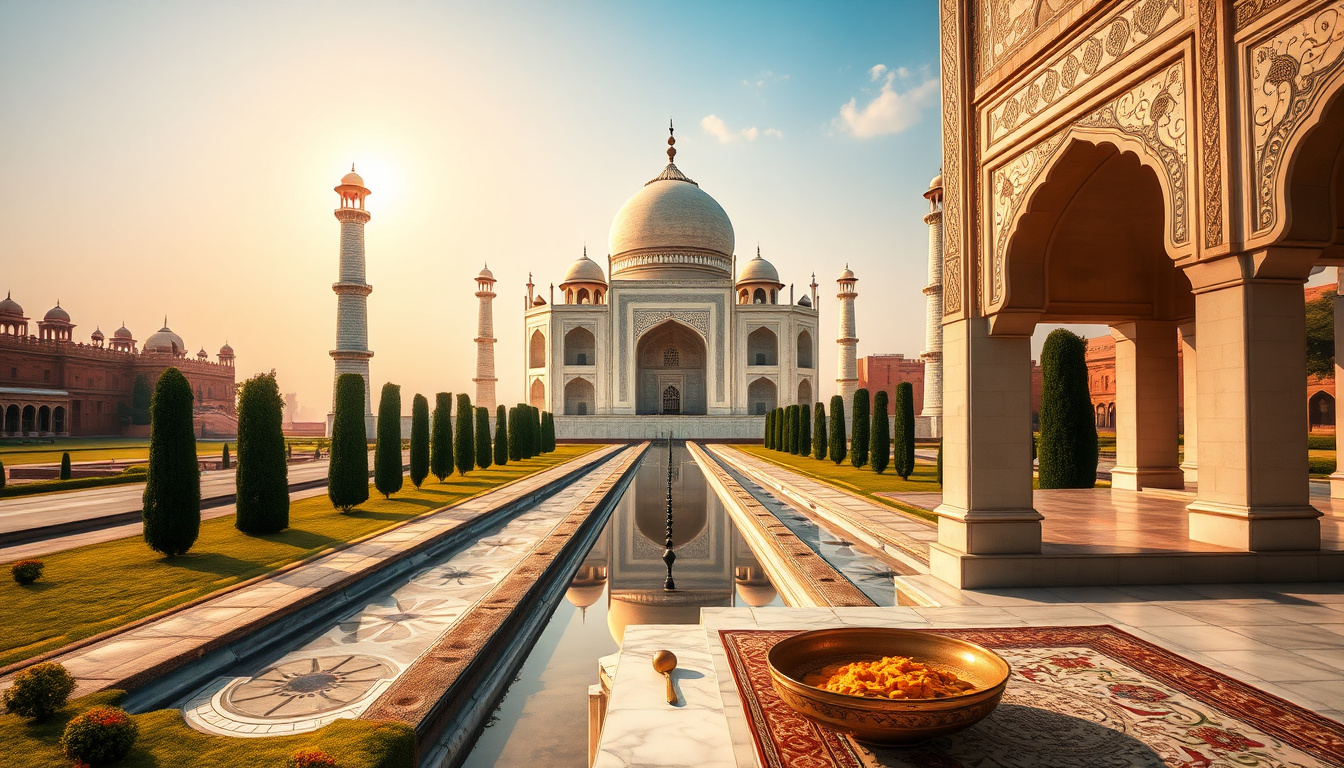
The Taj Mahal wasn't just a tomb. It was Shah Jahan saying: "My love is so profound that I'm spending the entire treasury to prove it." Was it practical? No. Was it politically smart? Debatable. But did it create the most iconic monument in human history? Absolutely. And for you in the exam, know this: the Taj Mahal represents Mughal architecture at its absolute peak—a blend of Persian, Islamic, and Indian styles.
This era (roughly 1600–1700) saw an explosion of Mughal culture that influenced everything:
Architecture: Domes, arches, gardens with flowing water (Mughal gardens), intricate marble work. Every monument built during this time followed Persian principles but added Indian elements. The Red Fort in Delhi, the Jama Masjid, the Agra Fort—all masterpieces of this synthesis.
Cuisine: Ever wondered why Indian restaurant menus have "Mughlai" sections? That's because Mughal emperors brought their Persian and Central Asian cooking styles and fused them with local Indian spices and ingredients. Biryani, kebab, korma—all Mughal contributions. I tell my students: "You can taste history in Mughal food."
Literature and Poetry: The court language was Persian, and the Mughal court became the patron of poets and writers. Urdu as a language developed during this period, blending Persian, Turkish, Arabic, and Hindi. If you ever wondered why Urdu is so closely tied to Mughal history, now you know.
The Administrative Genius Behind the Scenes
Here's what separates great empires from small kingdoms: administration. The Mughals created a system that could collect taxes, maintain armies, build cities, and keep everything organized across hundreds of thousands of square kilometers.
The Mansabdari system I mentioned earlier? It was genius. Imagine this: every officer got a rank (mansab) that determined their salary and military obligations. So a rank of 5,000 meant you had to maintain 5,000 cavalry troops. This system linked salary to performance and kept the military always loyal and ready. It's like having a point system for government employees—brilliant!
| Emperor | Ruled | Key Achievement | What Went Wrong |
|---|---|---|---|
| Babur | 1526–1530 | Founded empire; won Panipat | Died early; didn't consolidate |
| Humayun | 1530–1556 | Reconnected dispersed empire | Weak reign; lost power temporarily |
| Akbar | 1556–1605 | Greatest ruler; built stability | None major; left empire strong |
| Jahangir | 1605–1627 | Patronized arts; stable reign | Power gradually shifted to wife |
| Shah Jahan | 1628–1658 | Built Taj Mahal; golden age | Drained treasury; military weakened |
| Aurangzeb | 1658–1707 | Expanded territory; strict rule | Religious orthodoxy; internal decay |
The Slow Decline: Why Giants Fall
Now here's where the story gets tragic, and frankly, important for your exam. The Mughal Empire didn't collapse overnight. It slowly declined over a century, and understanding why teaches you more about history than any flashcard ever could.
Aurangzeb and the Seeds of Destruction
Aurangzeb (ruled 1658–1707) was intense. He was orthodox in his Islamic beliefs, militarily capable, and absolutely determined to expand the empire. But he also represented a fundamental shift from Akbar's inclusive philosophy.
Where Akbar said "sulh-i-kul" (universal peace), Aurangzeb reintroduced religious orthodoxy. He reimposed the Jizya tax on non-Muslims, destroyed some Hindu temples, and alienated large sections of his own population. It's a classic historical mistake: when you stop including people and start excluding them, you create resentment. And resentment, over time, becomes rebellion.
Aurangzeb spent so much time fighting in the Deccan (south India) that the north was left unattended. The Marathas, under Shivaji and later his successors, grew stronger and stronger. The Sikhs, facing religious persecution, became militant. Regional kingdoms started establishing independence.
The Structural Collapse
By the early 1700s, the Mughal Empire still existed on maps, but it was like a building that looked fine from outside but had termites eating it from within.
Economic drain: The Treasury was empty. Constant wars, massive construction projects, and a bloated bureaucracy meant the empire was spending more than it earned. This is a lesson that applies to nations even today: you can't keep spending money you don't have.
Military weakness: The Mansabdari system, once brilliant, had become corrupted. Officers collected salaries but didn't maintain troops. The army that had once conquered empires was now a shell of its former strength.
Rise of regional powers: The Marathas, the Sikhs, the Rajputs—everyone was establishing their own kingdoms. The central authority that Akbar had built so carefully was fragmenting.
European intervention: By the 1750s, the British East India Company and the French weren't just traders anymore. They were becoming military powers. The Battle of Plassey (1757) showed that the Mughal Empire couldn't even defend itself against a commercial company with an army.
The Mughal Legacy: Why They Still Matter
Here's the question I always get from students: "Sir, the Mughals have been gone for 170 years. Why are they still in our syllabus?" And my answer is simple: because they're not really gone.
The Mughal Empire left us with so much:
Administrative systems: Many of the bureaucratic structures that India uses today have roots in Mughal administration. The concept of a centralized government with provincial divisions? That's Mughal thinking.
Architectural inheritance: Every red sandstone building you see with those distinctive arches, every marble-inlaid floor, every garden with its symmetrical water channels—that's Mughal influence. Your city probably has a Mughal monument you walk past without even thinking about it.
Culinary tradition: Indian cuisine as the world knows it is, in many ways, Mughal cuisine. Biryani, nihari, kebabs, kormas—these aren't just dishes. They're cultural products of the synthesis between Mughal and Indian traditions.
Language: Urdu, Hindi, even English-Hindi mix (Hinglish) as we speak it—all influenced by Mughal-era linguistic mixing. When you say "khana" for food, "pani" for water, "kamra" for room, you're using words that came through the Mughal period.
Artistic traditions: Mughal miniature painting, calligraphy, poetry forms like the ghazal—these art forms are still practiced and admired today.
For your exam, the key is this: the Mughal Empire is a case study in how empires rise through good administration and inclusive policies, and decline through rigidity and internal conflict. If you understand that, you understand not just medieval India, but patterns of history that repeat themselves.
Practice Questions for Your Next Mock Test
A) The Mansabdari system B) Provincial governors (subahs) C) The Jagirdari system D) Abolition of Jizya tax
Answer: C) The Jagirdari system (This was from earlier sultanates, not Akbar's innovation)
A) Babur B) Akbar C) Shah Jahan D) Aurangzeb
Answer: B) Akbar (This was his inclusive approach to governance)
A) Rise of the British East India Company B) Reintroduction of religious orthodoxy and the Jizya tax C) Overexpansion into Southeast Asia D) Invasion by the Safavid Empire
Answer: B) Reintroduction of religious orthodoxy and the Jizya tax (This alienated large populations and created internal discord)
A) Jahangir B) Shah Jahan C) Akbar D) Aurangzeb
Answer: B) Shah Jahan (Built as a mausoleum for his wife Mumtaz Mahal)
A) It was a land-based tax system B) Ranks were hereditary and couldn't be changed C) Officers received salary and military obligations based on their rank D) It was abolished by Akbar and restored by Aurangzeb
Answer: C) Officers received salary and military obligations based on their rank (This tied compensation directly to responsibility)
Published by Dattatray Dagale • 16 August 2026
.jpg)
.png)


.png)




0 Comments