Introduction
Let me start with a confession: when I first taught human body systems to my students about a decade ago, I used to treat them like isolated machines. The circulatory system was one chapter, the digestive system another, and so on. Then one day, a bright student asked me, "Sir, if the digestive system breaks down food and the circulatory system carries it, why do we treat them separately?" That question changed how I teach this topic entirely.
You see, your body isn't a collection of independent systems working in silos. It's an orchestra. And like any good orchestra, every instrument depends on every other instrument to create harmony. When you're preparing for SSC CGL or UPSC, understanding this interconnectedness is what separates a 70% score from a 95% score on biology questions.
In this post, I'm going to walk you through all 11 major body systems the way I explain them to my students — with real examples, practical tricks, and an emphasis on how they all work together. By the end of this, not only will you have the facts, you'll have the *understanding* that makes these facts stick.
The 11 Major Systems and How They Function
1. The Circulatory System: Your Body's Highway
Imagine Delhi's traffic system, but instead of cars, you have blood cells, and instead of roads, you have blood vessels. The circulatory system is your body's delivery network, and the heart is the traffic police officer keeping everything moving.
Here's what happens: your heart pumps blood through arteries (thick-walled vessels carrying oxygen-rich blood away from the heart) and capillaries (super-thin vessels where actual nutrient exchange happens). Veins bring the used blood back to the heart. Simple, right? But here's what students often miss — the circulatory system doesn't just deliver nutrients. It also delivers hormones, immune cells, and carries away waste products. It's doing at least three jobs simultaneously.
Fun fact I tell my students: if you were to stretch out all the blood vessels in your body in a line, they'd wrap around Earth about 2.5 times. Your body is literally wired.
2. The Respiratory System: Your Oxygen Importer
This is where the magic happens. Every cell in your body is screaming for oxygen, and your respiratory system is the sole supplier. When you breathe in, air travels through your nasal passage, down the trachea, branches into bronchi, and finally reaches tiny little air sacs called alveoli. Here, oxygen crosses into your blood, and carbon dioxide (waste) comes out. It's a perfect swap.
Now here's what makes this interesting for exam purposes: the respiratory system doesn't work alone. It needs the circulatory system to transport the oxygen it captures. They're literally dependent on each other. This is the interconnectedness I mentioned earlier.
3. The Digestive System: Your Body's Factory
Food goes in, nutrients come out. But the journey is intricate. Saliva in your mouth starts breaking down carbohydrates. Your stomach acid does the heavy lifting on proteins. Your small intestine (which is actually about 20 feet long — "small" refers to diameter, not length!) absorbs most nutrients. Your large intestine absorbs water and forms stool.
Here's a trick I teach all my students: remember the organs in order with this phrase: "**M**outh **S**wallows **S**tomach **S**mall-intestine **L**arge-intestine **R**ectum **A**nus" — make your own mnemonic using the first letters. I remember it as the digestive "route."
4. The Nervous System: Your Body's Communication Network
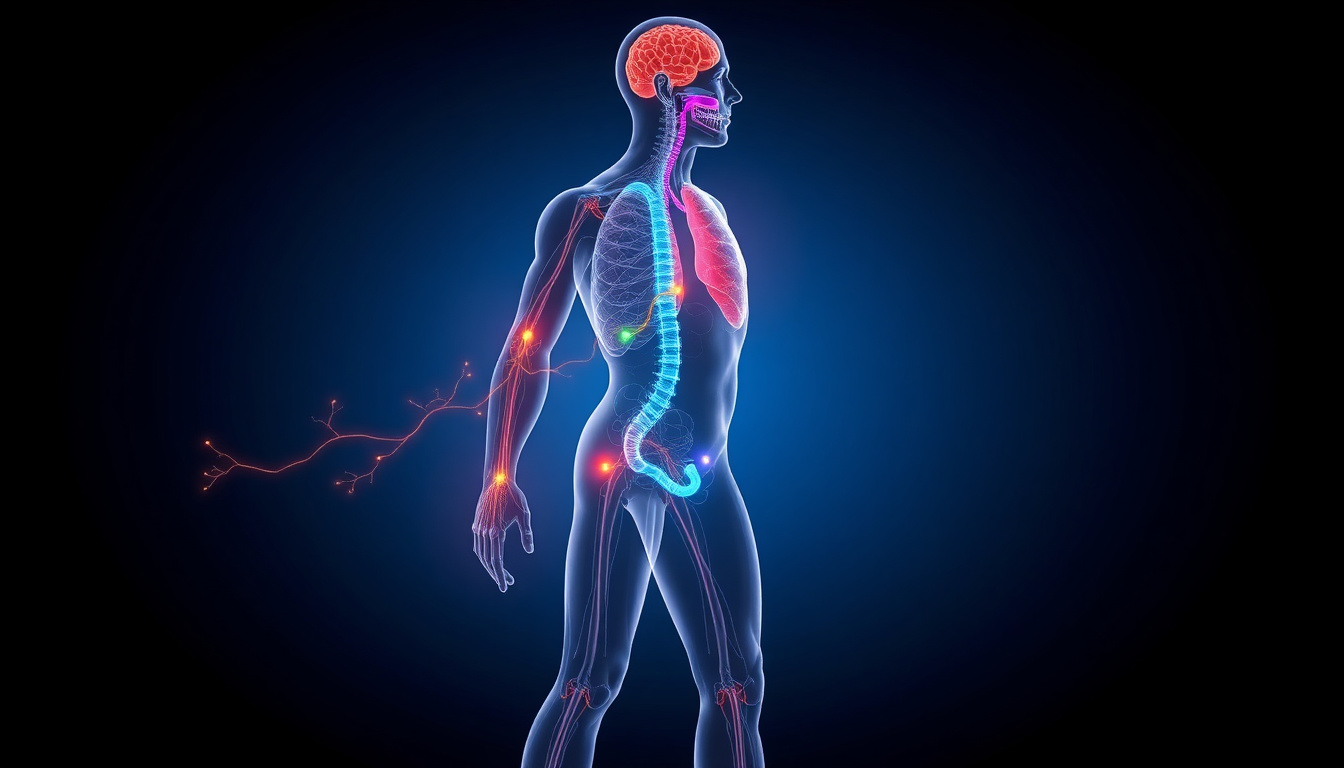
If your body were a company, the nervous system would be the internal communication department. It has two main parts: the central nervous system (brain and spinal cord) and the peripheral nervous system (nerves extending everywhere).
What students often don't realize is how *fast* this system operates. When you touch a hot pan and your hand pulls away, that's not because your brain deliberately decided to move your hand. That's your spinal cord making a reflex arc decision in milliseconds. Your brain finds out *after* your hand is already safe. Pretty cool, right?
5. The Endocrine System: Your Body's Chemical Messenger
While the nervous system uses electrical signals, the endocrine system uses chemical messengers called hormones. The pituitary gland is the master gland, the thyroid controls metabolism, the pancreas controls blood sugar — each gland produces specific hormones for specific jobs.
Here's what makes this important: when your body needs a slower, longer-lasting response (like managing stress or reproduction), the nervous system alone isn't enough. It calls in the endocrine system. In exams, students often confuse which system does what. Remember this: nervous system = quick reactions (seconds), endocrine system = sustained responses (hours to days).
6. The Musculoskeletal System: Your Body's Structure
Bones provide framework and protection. Muscles provide movement. Together, they're your body's architecture and engineering.
A fact that always amazes students: your bones are living tissue. They constantly break down old bone and rebuild new bone. Every 7-10 years, your skeleton is essentially brand new. Also, muscles don't just pull in one direction — when you bend your arm, the biceps contracts while the triceps relaxes. They work in pairs. This is important for understanding movement.
7. The Immune System: Your Body's Defense Force
White blood cells are your body's soldiers. When a pathogen (bacteria, virus) invades, your immune system identifies it, fights it, and remembers it for next time. That's why you don't catch the same disease twice (usually).
The immune system works through multiple layers: skin (physical barrier), stomach acid (chemical barrier), white blood cells (cellular barrier), and antibodies (chemical attack). It's not one-layered — it's a multi-layered defense system like a fort.
8. The Urinary System: Your Body's Waste Cleaner
The kidneys filter blood, removing waste products and excess water. This forms urine. The ureters carry it to the bladder, which stores it, and the urethra expels it. Simple as that. But don't underestimate the kidneys — they're so important that you can live with just one, but you can't live without at least one.
9. The Reproductive System: The Continuity Engine
In males: testes produce sperm. In females: ovaries produce eggs. Both systems are influenced by hormones from the endocrine system. This is another beautiful example of system interconnectedness.
10. The Integumentary System: Your Body's Barrier
Skin is more than a covering. It's a sensory organ, a temperature regulator, a barrier against pathogens, and a vitamin D producer. When you're hot, your skin dilates blood vessels to release heat. When you're cold, it constricts them to conserve heat.
11. The Lymphatic System: Your Body's Drainage and Backup Immune System
While the circulatory system carries blood, the lymphatic system carries lymph (a clear fluid) and helps fight infections. It's like your body's secondary highway system for fluid movement and immune support.
How These Systems Work Together: The Real Story
Now let me tell you the story of what happens when you eat a samosa (because let's be real, that's what most of my students are doing while studying).
You bite into the samosa. Immediately, the digestive system starts working — saliva begins breaking down carbohydrates. As you chew, the musculoskeletal system (muscles and jaw) does the mechanical work. You swallow, and the food travels down. Your stomach acid breaks it down further. In your small intestine, nutrients are absorbed.
Meanwhile, your circulatory system is standing by with its delivery trucks (blood cells) ready. The moment nutrients are absorbed, the circulatory system picks them up and distributes them throughout your body. Every cell that needs energy gets it. The respiratory system ensures there's enough oxygen for this entire process. The endocrine system (pancreas) releases insulin to help cells absorb glucose.
The nervous system is monitoring everything — blood sugar levels, nutrient availability, energy status — and sending signals. Any excess nutrients get stored, thanks to hormonal signals. Waste products from this entire process are filtered by the urinary system and excreted. The immune system stands guard to ensure no pathogens entered with the food.
All of this — the entire magnificent process — happens in a few hours, involving at least 7-8 major systems working in perfect coordination. This is what your examiners are testing when they ask about body systems. They want to know not just what each system does, but how they all fit together.
Key Points for Exam Success
Memorization tip for the nervous system: Remember "**C**entral = Brain + Spinal cord, **P**eripheral = everything else." Central is the command center, Peripheral is the field operations.
For the endocrine system: The "**P**ituitary is **P**resident" — it's the master gland that controls others. The thyroid controls metabolism. The pancreas controls blood sugar. The adrenal glands control stress response.
For the digestive system: Most absorption happens in the small intestine, not the stomach. This surprises many students. The small intestine has villi and microvilli that increase surface area for absorption.
| System | Primary Function | Key Organs |
|---|---|---|
| Circulatory | Transport nutrients & oxygen | Heart, arteries, veins, capillaries |
| Respiratory | Gas exchange | Lungs, trachea, bronchi |
| Digestive | Nutrient breakdown & absorption | Mouth, stomach, small intestine, large intestine |
| Nervous | Communication & control | Brain, spinal cord, nerves |
| Endocrine | Hormone production & regulation | Pituitary, thyroid, pancreas, adrenal glands |
| Immune | Defense against pathogens | White blood cells, lymph nodes, spleen |
| Urinary | Waste elimination | Kidneys, bladder, ureters |
| Musculoskeletal | Structure & movement | Bones, muscles, joints |
Practice Questions to Test Your Understanding
A) Stomach B) Small intestine C) Large intestine D) Mouth
Answer: B) Small intestine — The small intestine has villi and microvilli that provide enormous surface area for absorption. The stomach mainly stores and churns food; the large intestine primarily absorbs water.
A) Nervous system is slower; endocrine is faster B) Nervous system is faster; endocrine is slower C) Both have the same speed D) It depends on the organ
Answer: B) Nervous system is faster; endocrine is slower — The nervous system operates in milliseconds via electrical signals (ideal for reflexes), while the endocrine system works in hours to days via hormones (ideal for sustained responses like growth and metabolism).
A) Thyroid B) Pancreas C) Pituitary D) Adrenal
Answer: C) Pituitary — The pituitary gland controls the secretion of other endocrine glands, making it the master gland. It has two lobes: anterior and posterior, each with different functions.
A) Pump blood throughout the body B) Drain interstitial fluid and support immunity C) Produce hormones D) Break down food
Answer: B) Drain interstitial fluid and support immunity — The lymphatic system collects excess fluid from tissues, filters it through lymph nodes (where immune cells fight pathogens), and returns it to the bloodstream.
A) Your stomach digesting food B) Your hand pulling away from a hot surface C) Your pancreas releasing insulin D) Your skin producing vitamin D
Answer: B) Your hand pulling away from a hot surface — A reflex arc is a rapid, automatic response that doesn't require brain involvement. The sensory neuron detects heat, the spinal cord processes it, and the motor neuron causes muscle contraction—all before your brain is even aware of the danger.
Final thought from my years of teaching: Don't just memorize facts about these systems. Visualize them. Understand them as a living, breathing orchestra where every musician (system) depends on every other musician. When you walk into that exam hall, you won't just be answering questions about body systems — you'll be telling the beautiful story of how your body keeps you alive, every single second of every single day. And that story, my friend, is worth remembering.
All the best for your preparation. If you have questions or want me to explain any system in more detail, let me know in the comments. That's what I'm here for.
Published by Dattatray Dagale • 04 August 2026
.jpg)
.png)



.png)




.png)

0 Comments