Introduction
Let me start with something that happened in my classroom last year. A student asked me, "Sir, why do we even need to study cells? I mean, I can't see them. Why should I care?" And honestly? I loved that question because it meant he was thinking.
Here's what I told him: "You're made of approximately 37 trillion cells right now. In the time it takes you to read this sentence, millions of them will die and be replaced. Your body is essentially running the most complex factory on Earth, and you don't even need to think about it." His eyes lit up. That's when biology stops being boring textbook stuff and becomes absolutely fascinating.
The thing is, cell biology isn't just about memorizing parts of a cell like you're reading an Ikea manual. It's about understanding the choreography of life itself. Every sneeze, every thought, every time you score a goal on the football field — it's all happening because of processes that start at the cellular level. And yes, this knowledge will definitely help you crack those tricky SSC and UPSC questions, but more importantly, it'll help you understand yourself.
The Cell: Your Body's Smallest City
What Actually Is A Cell?
Imagine your body as a country. Cities are organs. Neighborhoods are tissues. And cells? Cells are the individual houses where the actual work happens. That's the simplest way I can put it.
A cell is the basic unit of life. Full stop. It's the smallest living structure that can perform all the functions of life. Now, this is important — I'm not saying a cell can "kind of" do these things. A single cell is completely alive. It eats, it grows, it reproduces, it responds to its environment. Some cells like bacteria are literally entire organisms by themselves.
You have two main types of cells in your body: prokaryotic and eukaryotic. Let me break this down with something you'll remember.
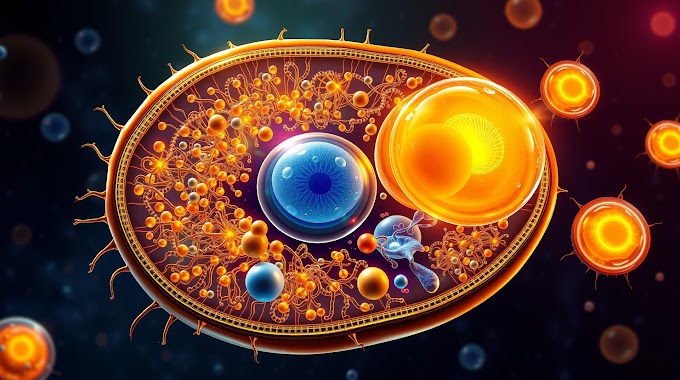
Prokaryotic cells (bacteria and archaea) are like a small shop where the owner does everything themselves — no departments, no organization, just controlled chaos that somehow works. Eukaryotic cells (your cells, plant cells, animal cells) are like a massive multinational company with different departments, each with its own office and specialized jobs.
The Structure: Understanding Organelles Like Your Daily Life
Here's my favorite way to remember the main organelles. I call it the "Corporate Office Trick" and every student I've taught remembers this:
N-E-M-R-G-P-L-R = Nucleus, Endoplasmic Reticulum, Mitochondria, Ribosomes, Golgi apparatus, Peroxisomes, Lysosomes, Rough/Smooth ER
But let me actually explain these by comparing them to a real company:
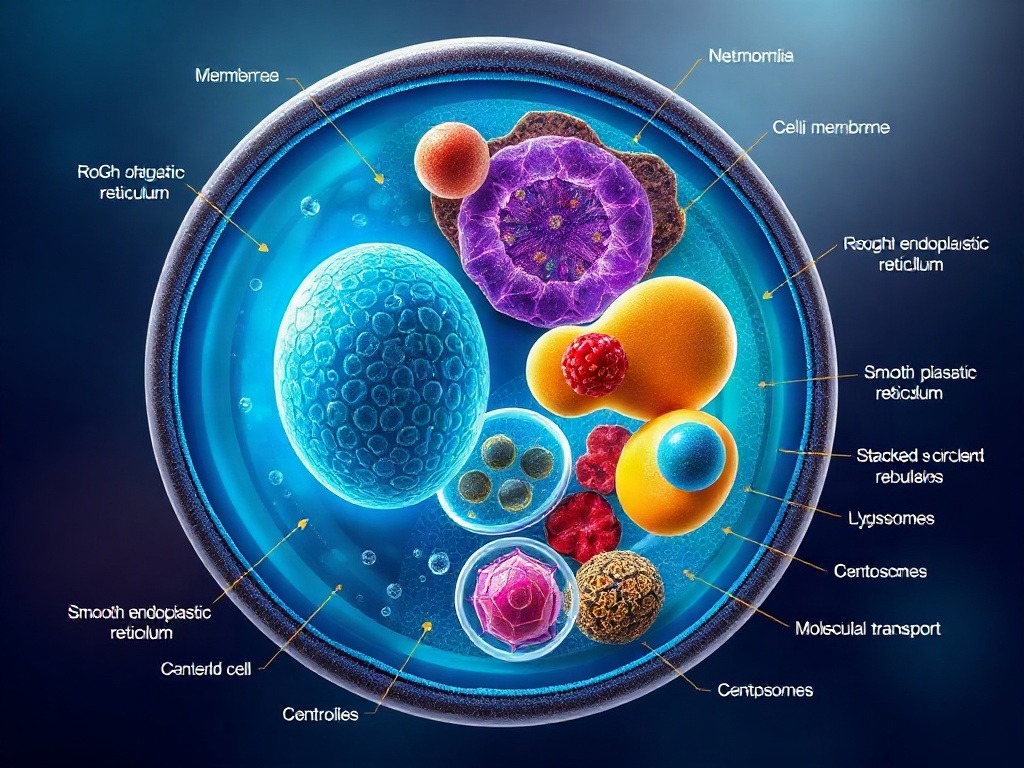
Nucleus is the CEO's office. It contains your DNA (the instruction manual) and controls everything that happens in the cell. You literally cannot do anything without the nucleus saying it's okay.
Mitochondria — now here's one every student must understand for exams — this is the power plant. The powerhouse of the cell. It generates ATP (Adenosine Triphosphate), which is basically the currency of energy in your body. No ATP? You're dead. Literally. Every movement, every thought, every heartbeat runs on ATP.
Endoplasmic Reticulum (ER) comes in two versions. Rough ER (with ribosomes attached) is where proteins are made. Smooth ER is where lipids and carbohydrates are made. Think of rough ER as the manufacturing department and smooth ER as the processing department.
Ribosomes are the actual workers who build proteins. They read the instructions from DNA (carried by mRNA) and assemble amino acids in the correct sequence. It's like a factory worker following a blueprint.
Golgi Apparatus — this is the packaging and shipping department. Proteins made in the ER come here to be modified, packed into vesicles, and sent where they're needed.
Lysosomes are the cleaning crew. They contain digestive enzymes that break down waste materials and dead cell parts. In plant cells, the large central vacuole does this job.
Now here's the interesting part that most textbooks skip: each of these organelles has a membrane. That's crucial. It means each department is separate from the others. Lysosomes don't accidentally digest your mitochondria because there's a protective barrier. Beautiful design, really.
Life Processes: The Five Things That Keep You Alive
Remember MRS GREN (Or MRS Gren Grows Rapidly)
This is probably the most classic mnemonic in biology, and for good reason. Every living thing — whether it's you, a plant, a bacteria, or even a virus — must have these characteristics:
M – Metabolism (using energy)
R – Respiration (converting food to usable energy)
S – Sensitivity (responding to environment)
G – Growth (increasing in size)
R – Reproduction (making more of yourself)
E – Excretion (getting rid of waste)
N – Nutrition (taking in food)
Let me give you a practical example. Right now, you're breathing (respiration), your body is using energy to think and maintain temperature (metabolism), if someone suddenly claps, you'll jump (sensitivity), you've grown taller since you were 5 (growth), your body is removing carbon dioxide and urea (excretion), and you'll need lunch soon (nutrition). If something couldn't do all seven of these, it's not living. That's the gold standard.
Respiration: Not Just About Breathing
Here's where students often get confused. Respiration isn't just breathing. Breathing is the physical act of moving air in and out of your lungs. Respiration is the chemical process of breaking down glucose to release energy.
It happens in two forms:
Aerobic Respiration (with oxygen): This is the main event. It happens in your mitochondria. Glucose + Oxygen → Carbon Dioxide + Water + Energy (ATP). One glucose molecule can produce up to 38 ATP molecules. Incredibly efficient. This is what you're doing right now, assuming you're breathing normally.
Anaerobic Respiration (without oxygen): This is the emergency mode. Your muscles use this when you sprint in a cricket match and your lungs can't supply oxygen fast enough. It produces lactic acid (which makes your muscles burn) and only 2 ATP molecules per glucose. Less efficient but works in a pinch. This is also why your legs hurt after running — it's the lactic acid buildup.
In plants, respiration works the same way, but they do photosynthesis during the day to make glucose, then respire it at night. It's basically the reverse of photosynthesis.
Nutrition and Transport: Getting What You Need Where You Need It
Your cells don't just absorb random stuff from your bloodstream like a chaotic buffet. Transport is highly regulated and incredibly selective.
There are three main ways substances move across cell membranes:
Diffusion — Molecules move from where there's more of them to where there's fewer of them. Think of it like people leaving a crowded Mumbai local train to stand in less crowded areas. No energy needed; it just happens naturally.
Osmosis — This is specifically water molecules moving across a semipermeable membrane. Again, toward where there are fewer water molecules (more dissolved particles). This is why plants wilt when you forget to water them — water moves out of the cells.
Active Transport — Sometimes your cells need to move something against the natural gradient. This requires energy (ATP). Imagine lifting water uphill. Your cells do this when they need to accumulate something that naturally wants to be elsewhere. Ion pumps are a perfect example — your cells pump sodium out and potassium in, using ATP, to maintain the right balance.
| Life Process | What Happens | Where It Happens | Quick Example |
|---|---|---|---|
| Respiration | Breaking down glucose for energy | Mitochondria (aerobic) | Your muscles using glucose when you run |
| Photosynthesis | Making glucose using sunlight | Chloroplasts (plants only) | Plants using sunlight to make food |
| Excretion | Removing waste products | Liver, kidneys, skin | Your body eliminating urea through sweat and urine |
| Growth | Cell division and increase in size | Throughout the body | You getting taller from age 5 to 18 |
| Reproduction | Making new cells or organisms | Cell nucleus (mitosis/meiosis) | Your skin cells constantly dividing to replace dead ones |
Cell Division: The Sequel to Growth
You know what fascinates me most? Right now, your body is replacing about 300 billion cells per day. That's not a typo. Your red blood cells last about 120 days. Your skin cells last about 2-4 weeks. Some cells in your gut last just 3-5 days. And your entire body replaces itself roughly every 7-10 years. You're literally not the same person you were a decade ago.
This replacement happens through cell division. There are two main types:
Mitosis — This is regular cell division for growth and repair. Your body does this millions of times every day. One cell divides into two identical daughter cells, each with the same genetic information as the parent cell. It's how you heal from cuts, grow taller, and maintain your tissues.
Meiosis — This is the special division that creates sex cells (sperm and eggs). It's different because it produces cells with half the genetic information. That's why you need both a sperm and an egg to make a complete person — each contributes half the chromosomes. This is also why you don't look exactly like your mom or your dad, but like a combination of both.
Here's a useful memory trick I've taught hundreds of students:
"MITOSIS is for growth; MEIOSIS makes sex cells."
Or even better: **"Mitosis makes Me (identical copies), Meiosis makes the opposite (half cells)."** The actual stages are: Prophase → Metaphase → Anaphase → Telophase (PMAT). Happens in mitosis twice for meiosis. But if your exam just asks you to understand the concept, that's what matters most. After years of marking answer sheets, I've noticed students make the same mistakes repeatedly. Let me save you from these: Trap 1: Confusing respiration with breathing. Respiration is cellular and chemical. Breathing is mechanical and physical. You can have respiration without breathing (anaerobic), but you can't breathe without respiration happening. Trap 2: Thinking only plants do photosynthesis. Some bacteria and algae do too. Some even do it without oxygen (anoxygenic photosynthesis). The question might say "Which organism performs photosynthesis?" and the answer might not be a plant. Trap 3: Forgetting that plant cells have cell walls and animal cells don't. Cell wall provides structure and rigidity. That's why plants stand up straight and we'd be jelly without our skeletons. Trap 4: Mixing up ATP production numbers. Aerobic respiration = ~30-38 ATP per glucose. Anaerobic respiration = 2 ATP per glucose. Questions often ask which is "more efficient." Trap 5: Assuming all life processes happen at the same speed everywhere. They don't. Temperature, pH, oxygen availability — everything affects the rate. This is why tropical regions have more decomposition (faster excretion of dead matter) than Arctic regions. Before you leave, let me tell you something I tell every batch of students: biology isn't about memorization. It's about understanding the logic. Every organelle has a reason. Every process has a purpose. Once you see the logic, the exam questions become predictions you can make yourself. Study hard, but study smart. And remember — you're made of trillions of cells working in perfect harmony right now. If they can organize themselves that well, you can definitely organize your study plan.Common Exam Traps and How to Avoid Them
A) Golgi Apparatus B) Mitochondria C) Ribosome D) Endoplasmic Reticulum
Answer: B) Mitochondria — This is the powerhouse of the cell where aerobic respiration occurs, producing ~30-38 ATP molecules per glucose molecule.
A) Mitosis produces identical diploid cells; meiosis produces genetically different haploid cells B) Mitosis is faster than meiosis C) Meiosis only occurs in males D) There is no real difference, just terminology
Answer: A) Mitosis produces identical diploid cells; meiosis produces genetically different haploid cells — Mitosis makes identical copies for growth; meiosis creates sex cells with half the chromosomes.
A) Sensitivity B) Reproduction C) Consciousness D) Excretion
Answer: C) Consciousness — MRS GREN covers Metabolism, Respiration, Sensitivity, Growth, Reproduction, Excretion, and Nutrition. Consciousness is not listed as a defining characteristic of all life.
A) Pyruvate B) Ethanol C) Lactic acid D) Carbon dioxide
Answer: C) Lactic acid — In anaerobic respiration, glucose is broken down to produce lactic acid instead of CO2 and water, causing muscle fatigue and burning sensation.
A) Diffusion B) Osmosis C) Active Transport D) Facilitated Diffusion
Answer: C) Active Transport — This process uses ATP to pump substances from low to high concentration, working against the natural gradient (e.g., sodium-potassium pump).
Published by Dattatray Dagale • 28 August 2026
.jpg)
.png)


.png)



.png)

0 Comments