Introduction
Let me start with a confession: when I first began teaching medieval history to SSC and UPSC aspirants, I used to treat the Mughal Empire like a shopping list. Dates here, emperors there, some battles thrown in, and done. But after about three years of seeing brilliant students fumble on exam day, I realized something crucial — they weren't struggling with facts. They were struggling to see the story.
The Mughal Empire isn't just another dynasty that ruled India for 300 years. It's the story of how a Central Asian warrior family essentially rewired the entire subcontinent — its administration, culture, art, language, and even the way Indians thought about themselves. And honestly? It's far more thrilling than most Bollywood films.
Here's what I tell my students: if you want to understand modern India — our syncretic culture, our architectural legacy, even the food we eat — you have to understand the Mughals. From the Persian-influenced administrative system to Urdu as a language, from the Taj Mahal to the concept of mansabdari, this empire literally shaped everything around you.
So let's dive in properly, shall we?
The Foundation: From Babur's Ambition to Akbar's Vision
Who Was Babur, Really?
Zahir ud-Din Muhammad Babur was born in 1483 in Andijan (in modern-day Uzbekistan), and here's something that fascinates me: he was never actually planning to conquer India. Let me explain.
Babur's original goal was to establish himself in Central Asia, particularly in Samarkand — the cultural capital of his dreams. But after losing out to the Uzbeks (those pesky neighbors!), he turned his attention southward toward Kabul, which he captured in 1504. For the next 20 years, Babur ruled Afghanistan, conducted raids into Punjab, and basically waited for his opportunity.
That opportunity came in 1526 when Ibrahim Lodi, the last Delhi Sultan of the Lodi dynasty, faced a rebellion. Daulat Khan Lodi, a noble, invited Babur to invade! Now, Babur could have simply plundered and left — plenty of raiders did that. But he was different. After crushing Ibrahim at the First Battle of Panipat (1526), he decided to stay. To build. To create something permanent.
Now here's a trick I teach all my students: remember "BABUR = Brilliant Administration, But Ultimately Restless". He laid the groundwork, but it was his descendants who truly stabilized the empire.
Akbar: The Man Who Actually Built the Mughal Empire
Babur ruled for only 4 years before dying in 1530. His son Humayun was brilliant but... let's say politically unlucky. He spent much of his reign being chased by Afghan rulers and actually lost his throne for 15 years! But here's where it gets good: when Humayun's son Akbar took the throne in 1556 at just 13 years old (under regent Bairam Khan), something extraordinary happened.
Akbar — and I genuinely believe this — was one of history's most forward-thinking rulers. Not just for medieval India, but for any era. While he was illiterate (yes, the greatest Mughal emperor couldn't read!), he had an almost supernatural ability to understand people and systems.
You might be wondering: how can an illiterate person build an empire? Here's the thing — Akbar had what I call "emotional intelligence before anyone invented the term." He understood that to rule a diverse, religiously complex subcontinent, you couldn't just conquer; you had to integrate.
Between 1556 and his death in 1605, Akbar:
- Expanded the empire from Delhi to cover most of North and Central India
- Introduced the mansabdari system (we'll discuss this in detail)
- Abolished the hated jizya tax on non-Muslims
- Married Hindu princesses and gave high positions to Hindu nobles
- Created a syncretic religious philosophy called Din-i-Ilahi
- Built the walled city of Fatehpur Sikri and established a magnificent court
His reign lasted 49 years, and by the end, the Mughal Empire had become what it should be — not just a Muslim dynasty ruling over Hindu subjects, but a genuinely integrated Indo-Islamic civilization.
The Administrative Genius: How the Mughals Actually Governed
The Mansabdari System Explained (Finally, in a Way That Makes Sense)
Okay, this is where most textbooks lose students. They give you the definition, you memorize it, you forget it by exam day. Let me try differently.
Imagine you're Akbar in 1576. You've got an empire stretching across thousands of kilometers. You can't be everywhere. Your nobles are all powerful landholders with their own armies, and you need them loyal. So what do you do?
You create a system where every noble gets a mansab — which literally means "rank" in Persian. This rank has two numbers attached to it: the zat (personal rank) and the sawar (cavalry rank). Here's where it gets clever — your salary, your status, your responsibility, everything was determined by these numbers. A general with a mansab of 5000/5000 was a powerful man indeed. A local administrator with 1000/500 was less so.
Now here's the genius part: this ranking was not hereditary. When you died, your son didn't automatically get your position. The Emperor re-evaluated. This meant every noble had to constantly prove their loyalty and competence. It was like a medieval performance review system!
Let me give you a memory trick: "MAN = Mobility, Authority, Non-hereditary". The mansab system ensured that officials were mobile (they could be transferred), had clear authority (based on their rank), and couldn't just pass down power to incompetent heirs.
The Revenue System: The Zabti and Jagirdar System
How did Akbar's government actually collect money? Through a system called the Zabti — a direct assessment of land revenue introduced by Akbar's finance minister Raja Todar Mal.
The Zabti system worked like this: land was surveyed, crops were assessed, and a fixed tax was levied. This sounds simple, but it was revolutionary because it was standardized and recorded. No more local landlords arbitrarily deciding how much to squeeze out of peasants. Everything was written down in Persian records.
There was also the jagirdar system, where instead of paying nobles directly in cash, the Mughals gave them rights to collect revenue from specific areas (called jaguirs). The jagirdar kept a portion and sent the rest to the Emperor. This incentivized them to keep order and maintain the land because their income depended on it. Clever, right?
| System | What It Did | Key Features |
|---|---|---|
| Mansabdari | Military and administrative ranking | Non-hereditary, merit-based, Zat + Sawar |
| Zabti | Land revenue assessment | Standardized, recorded, centralized |
| Jagirdar | Revenue collection rights in specific areas | Incentivized local development, transferable |
| Diwan-i-A'la | Chief minister/prime minister position | Handled finance and revenue matters |
Culture, Art, and Legacy: The Mughal Contribution to Indian Civilization
Here's something I absolutely love about the Mughals: they didn't just rule politically; they transformed India culturally. And the remarkable part? Much of it was so thoroughly integrated into Indian life that we now consider it distinctly Indian.
Architecture: From Temples to Taj Mahals
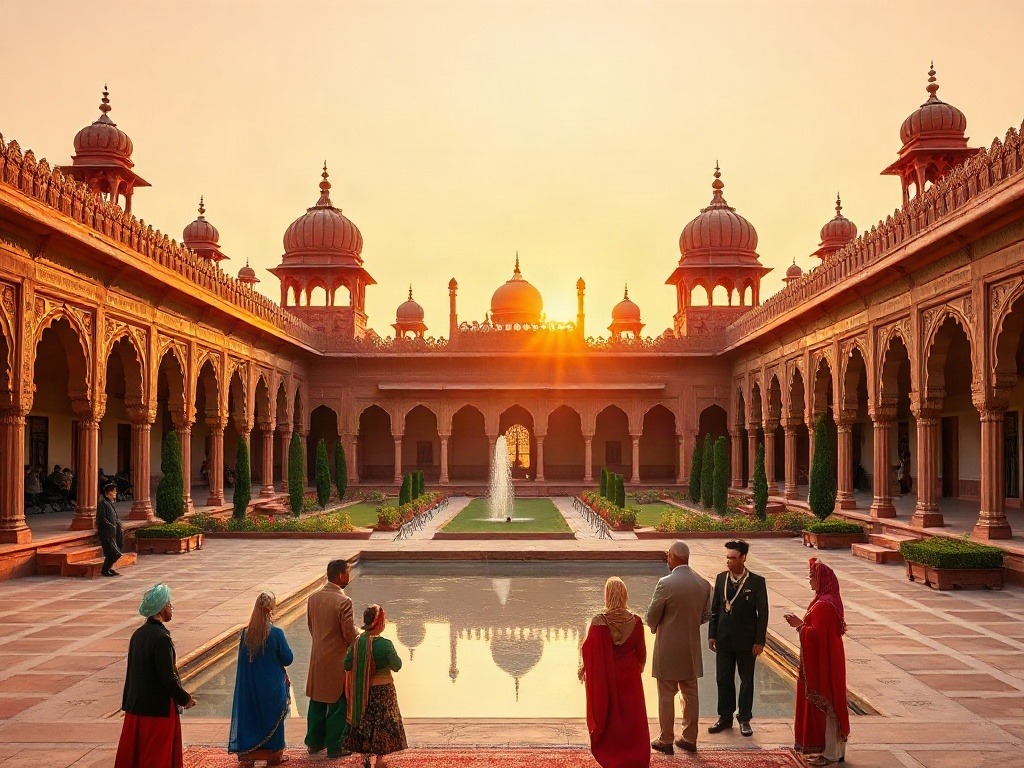
When you think of Mughal architecture, your mind immediately goes to the Taj Mahal, right? But here's what most people don't realize: Mughal architecture wasn't some foreign imposition. It was a fusion.
The Mughals came from Central Asia with Persian architectural traditions (domes, arches, intricate tile work). But they encountered Indian building styles (stone carving, water features, garden layouts). The result? Something entirely new and beautiful.
Look at Akbar's Fatehpur Sikri — it combines Islamic arches with Hindu temple elements. The Taj Mahal isn't just Persian; it's got Indian marble inlay and garden designs. The Red Fort in Delhi mixes everything together.
And here's my favorite part: some of the greatest Mughal monuments were built by Hindu architects and craftsmen! The Mughals had the vision and resources, but Indian artisans had the skill. That's integration.
Language and Literature: The Birth of Urdu
The Mughals brought Persian as the court language. Over time, it mixed with local languages — Hindi, Turkish, Arabic — and eventually became Urdu. This isn't just linguistic history; it's cultural history.
Persian literature flourished at the Mughal court. Akbar's court included poets like Faizi and Abul Fazl. Later, under Shah Jahan and Aurangzeb, we get the great poets like Mirza Ghalib (though he came later, in the decline phase).
The point I always make to students: Urdu is a Mughal legacy that's alive and thriving today. When you listen to Urdu poetry or read Urdu literature, you're engaging with medieval India's greatest cultural achievement.
Food, Fashion, and Daily Life
You know what's fascinating? Go to any Indian wedding, and you'll see elements of Mughal culture everywhere. The elaborate cuisine, the way hospitality is practiced, certain clothing styles — all Mughal influences.
The Mughals introduced things like biryanis (actually a Persian dish that became authentically Indian), kababs, and elaborate meat-based dishes. They established formal gardens (Mughal gardens) as spaces for leisure and contemplation. They brought sophisticated etiquette and court culture.
I always tell my students: Mughal culture is like a river — it flowed into every aspect of Indian civilization and became inseparable from it. That's why understanding the Mughals means understanding modern India.
The Decline: How an Empire Lost Its Way
Now, every story of greatness has a decline, and the Mughal story is no exception. After Akbar's reign (which lasted until 1605), we get his son Jahangir (1605-1627), then Shah Jahan (1627-1658), and finally Aurangzeb (1658-1707).
Here's the interesting bit: Jahangir and Shah Jahan are often romanticized (Shah Jahan built the Taj Mahal for his beloved Mumtaz, after all), but politically, they began the empire's slow decline. They were less interested in administration and more in personal grandeur. The Taj Mahal is magnificent, but it cost enormous resources. Jahangir's court became famous for wine and opulence rather than governance.
Aurangzeb is often portrayed as a strict fundamentalist who destroyed temples and levied the jizya again. There's truth to this — he was definitely more orthodox than Akbar — but he was also an incredibly effective military strategist who expanded the empire to its greatest territorial extent. The problem? He expanded it so much that it became ungovernable.
By 1707, when Aurangzeb died, the empire was already showing cracks. His successors were weak, regional governors began asserting independence, and by 1750, the Mughal emperor was essentially a figurehead controlling only Delhi and its surroundings.
Here's what I want you to remember: empires don't collapse suddenly. They weaken gradually through bad decisions, loss of focus, and failure to adapt. The Mughals went from Akbar's integrated vision to Aurangzeb's rigid orthodoxy. By the time anyone realized the problem, it was too late.
Quick Revision Tips for Your Exam
Alright, let me give you my teacher's wisdom. When questions about the Mughals come up in your SSC CGL or UPSC exam, here's what to focus on:
1. Dates are secondary; systems are primary. Don't just memorize "Akbar ruled 1556-1605." Understand why his 49-year reign was transformative. What systems did he create?
2. The mansabdari system is CRUCIAL for UPSC exams. Practice explaining it in 3-4 lines. Why was it non-hereditary? How did it maintain loyalty? This is a guaranteed question.
3. Remember the three phases: Foundation (Babur, Humayun), Consolidation (Akbar), and Decline (after Jahangir).
4. Cultural contributions are as important as political history.** The Taj Mahal, Urdu language, architectural fusion — these appear in both exam and general knowledge questions.
5. Akbar vs. Aurangzeb is a classic comparison.** Know how their policies differed, especially regarding religious tolerance and revenue systems.
Practice Questions to Test Your Knowledge
A) To collect taxes from peasants B) To rank nobles and ensure loyalty through non-hereditary positions C) To divide the empire into administrative zones D) To establish irrigation projects
Answer: B) To rank nobles and ensure loyalty through non-hereditary positions
A) Babur B) Akbar C) Shah Jahan D) Aurangzeb
Answer: B) Akbar
A) Military recruitment B) Standardize land revenue assessment C) Expand territorial boundaries D) Establish trading routes
Answer: B) Standardize land revenue assessment
A) Abolishing the jizya tax on non-Muslims B) Marrying Hindu princesses C) Appointing Hindu nobles like Raja Man Singh D) All of the above
Answer: D) All of the above
A) Ended the Delhi Sultanate and established Mughal rule B) Expanded Aurangzeb's empire southward C) Prevented Maratha invasions D) Established the mansabdari system
Answer: A) Ended the Delhi Sultanate and established Mughal rule
That's our deep dive into the Mughal Empire! I hope this made the period feel less like a list of names and dates, and more like a living, breathing chapter of history. The Mughals shaped who we are as Indians — culturally, administratively, linguistically. When you walk into your exam room, remember not just the facts, but the story behind them. That's what separates good answers from great ones.
Now go study, and don't hesitate to revisit the sections on mansabdari and Akbar's policies — those are examination gold!
Published by Dattatray Dagale • 10 September 2026
.jpg)
.png)



.png)


.png)


0 Comments