Introduction
Let me start with a confession: when I first started teaching SSC CGL aspirants about ecology and environment, I thought I'd lose half my class within 15 minutes. I mean, food chains, nutrient cycles, biodiversity indices — it all sounds so textbook-y and boring, right?
But then something clicked. One day, a student asked me, "Sir, why do we even need forests if we can just make oxygen in factories?" That one question opened up the entire world of ecosystem services for me. And I realized — ecology isn't just about memorizing terms. It's about understanding how everything is connected. It's like a cricket team where every player has a specific role, and if one player goes missing, the whole team falls apart.
Since that day, I've seen hundreds of students go from "ecology gives me a headache" to actually enjoying these questions. And you know what? Once you understand the relationships and the flow of energy, the entire topic becomes crystal clear. You'll start seeing ecology everywhere — in your garden, in that park where you jog, even in the news about climate change.
Today, I'm going to share exactly how I teach this topic to my students, complete with tricks, real examples, and why this matters beyond your exam.
The Foundation: What is an Ecosystem and Why Does It Matter?
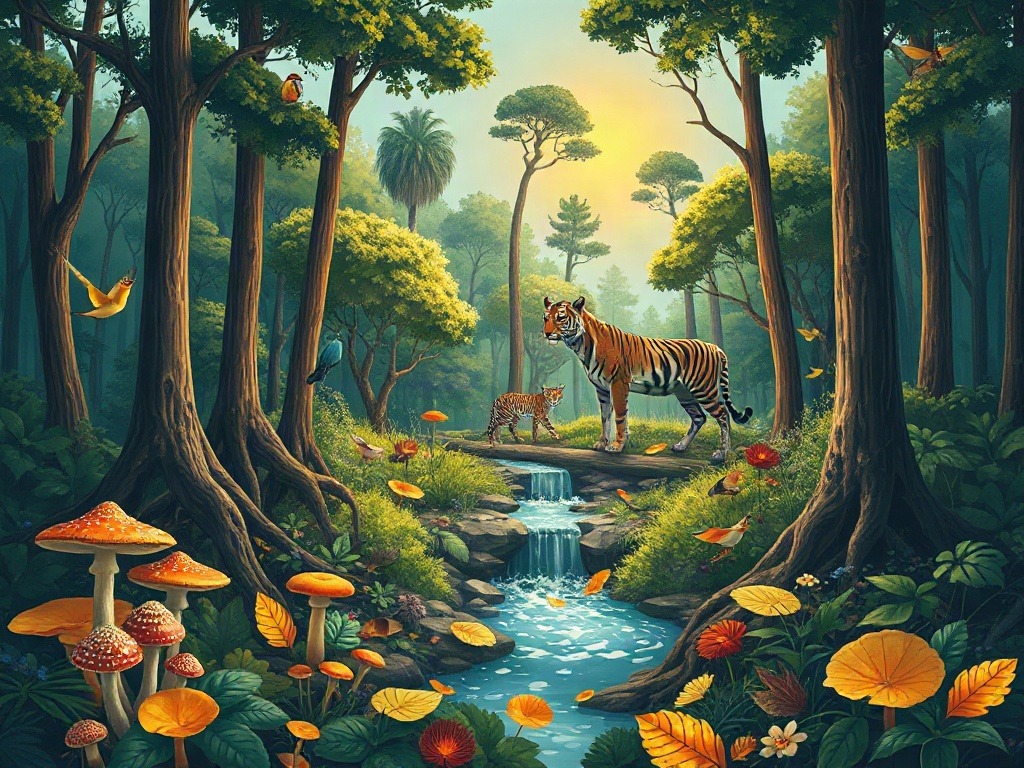
Before we dive deeper, let me clarify what we're actually talking about. An ecosystem isn't some fancy scientific term — it's simply a community of living things plus their physical environment, all working together. Your school is an ecosystem. Your colony is an ecosystem. The Western Ghats is an ecosystem. The Sundarbans is an ecosystem.
Now here's the thing most students miss: ecosystems aren't isolated. What happens in one ecosystem affects another. When we cut down forests in the Amazon, it affects rainfall patterns in India. When we pollute the Arabian Sea, it affects the fish that fishermen in Kerala catch. Everything is connected.
The Energy Flow: The Heart of Every Ecosystem
Let me give you a mnemonic I tell all my students, and honestly, it's a game-changer: "P-C-D-D" — Producers, Consumers (Primary), Consumers (Secondary and Tertiary), Decomposers.
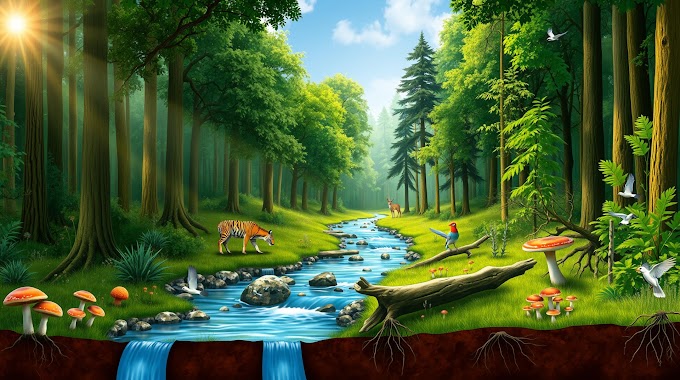
Picture this as a building. The Producers (plants, photosynthetic bacteria) are the foundation. They capture solar energy and convert it into chemical energy. Without them, nothing survives. The Primary Consumers (herbivores like deer, goats, grasshoppers) eat the producers. The Secondary and Tertiary Consumers (carnivores) eat the primary consumers. And the Decomposers (bacteria, fungi) break down everything that dies and return nutrients to the soil.
Energy flows in one direction: Sun → Producers → Primary Consumers → Secondary Consumers → Tertiary Consumers. But here's the crucial part that everyone forgets — energy decreases at each level. A plant captures maybe 1% of solar energy. The herbivore that eats the plant gets only about 10% of the plant's energy. The carnivore that eats the herbivore gets only 10% of that.
This is called the 10% Law. And you know what? This is why vegetarian populations can support more people than meat-eating populations. If we grow wheat and eat it directly, we get more nutrition than if we grow wheat, feed it to animals, and then eat the animals. This is basic thermodynamics, my friend.
Trophic Levels: The "Pyramid" That Keeps Your Exam Score High
Imagine a pyramid. The base is the widest and represents producers. As you go up, each level gets smaller. This is called a Pyramid of Energy, and it's always pyramid-shaped because of that 10% Law I just mentioned.
But here's where students often stumble: there's also a Pyramid of Numbers and a Pyramid of Biomass. The Pyramid of Numbers isn't always pyramid-shaped! Why? Imagine a large oak tree (one producer) supporting thousands of insects. The pyramid inverts! This is crucial knowledge for your exams.
Nutrient Cycles: The Recycling System Nature Invented (Long Before Recycling Became Trendy)
Energy flows, but nutrients cycle. Got it? Energy goes in one direction and eventually leaves as heat. But nitrogen, carbon, phosphorus, and water? They keep cycling back. This is why the Earth doesn't run out of these elements.
The Carbon Cycle: Why We Keep Talking About It
The Carbon Cycle is where I see the most confusion. Let me break it down like I would to a beginner: Carbon exists in the atmosphere as CO₂. Plants take it in (photosynthesis), animals eat plants, decomposers break down dead matter, and CO₂ goes back to the atmosphere. Seems simple, right?
But then we throw in fossil fuels. Coal and oil are just carbon that's been trapped underground for millions of years. When we burn them, we're releasing ancient carbon back into the atmosphere. This is the whole climate change story in a nutshell. We're disrupting a cycle that took millions of years to establish.
Here's a trick I use: "PLANTS-ANIMALS-DECOMPOSERS-ATMOSPHERE" — this is the natural cycle. When we burn fossil fuels, we're adding an extra input to the atmosphere that shouldn't be there.
The Nitrogen Cycle: The Invisible Lifeline
Nitrogen is in the air (78% of our atmosphere!), but plants can't use it directly. They need it in a usable form — nitrates or ammonium. This is where nitrogen-fixing bacteria come in. They live in soil and in the root nodules of legumes (like beans, peas). They convert atmospheric nitrogen into usable forms.
This is why crop rotation works so well in Indian agriculture. Farmers grow legumes one season, and it naturally replenishes nitrogen in the soil. The next season, they can grow nitrogen-hungry crops like wheat or rice without needing expensive fertilizers. This is traditional knowledge that's actually based on sound ecology!
The cycle completes when denitrifying bacteria convert nitrates back to atmospheric nitrogen. It's a closed loop that's been working perfectly for billions of years — until we started over-using synthetic fertilizers and polluting it.
| Nutrient Cycle | Key Process | Why It Matters |
|---|---|---|
| Carbon Cycle | Photosynthesis, respiration, decomposition | Regulates atmospheric CO₂; climate change |
| Nitrogen Cycle | Nitrogen fixation, nitrification, denitrification | Essential for protein synthesis in living things |
| Water Cycle | Evaporation, condensation, precipitation | Distributes water and heat across the planet |
| Phosphorus Cycle | Weathering, absorption, decomposition | Essential for DNA and ATP; doesn't have atmospheric stage |
Biodiversity: Why This Isn't Just Environmentalist Talk
Alright, this is where the topic becomes genuinely important — not just for your exam, but for your life. Biodiversity is the variety of life at all levels: genetic diversity, species diversity, and ecosystem diversity.
When we talk about the Amazon rainforest or the Western Ghats of India, we're talking about regions of incredible biodiversity. And why does it matter? Because:
First, genetic diversity means that some individuals in a population are naturally resistant to diseases or environmental stresses. If a disease hits, the resistant ones survive and pass their genes forward. This is evolution in action. A monoculture (like growing only one type of rice) is vulnerable — one disease wipes out everything.
Second, species diversity means the ecosystem is resilient. If one species disappears, others can compensate. But if you have very few species, the entire system becomes fragile.
Third, we've discovered that many medicines come from plants. The neem tree, turmeric, sandalwood — these are all biodiversity resources that humans use. Lose the forest, lose potential medicines that we haven't even discovered yet.
Why Habitat Loss Is the Real Culprit
You'll hear a lot about poaching, hunting, and pollution as causes of species extinction. And sure, they matter. But the biggest threat? Habitat loss. When we cut forests to build cities, when we drain wetlands for agriculture, when we dam rivers — we're not just removing individual animals. We're destroying entire homes for thousands of species.
Think of it this way: imagine if someone demolished your house while you were at work, and suddenly you had nowhere to live. That's what we're doing to wildlife every single day across India. This is why conservation areas and national parks are so critical. They're not just pretty places for tourists; they're insurance policies for our planet's survival.
Environmental Degradation and Global Issues That'll Definitely Come in Your Exam
Now we're getting into the topics that actually show up in SSC CGL questions. These are the "current" issues of ecology, and they're interconnected in fascinating ways.
Climate Change: The Ultimate Ecosystem Crisis
Rising temperatures affect precipitation patterns, which affects water availability, which affects agricultural productivity, which affects food security. See how it's all connected?
The greenhouse effect itself isn't bad — without it, Earth would be too cold for life. But we've enhanced it by releasing too much CO₂, methane, and nitrous oxide. These gases trap heat in the atmosphere like a blanket, raising global temperatures.
For your exam, remember: Global warming ≠ Climate change. Global warming is the symptom (rising temperatures). Climate change is the disease (altered weather patterns, ecological disruption). This is a question I've seen at least five times in SSC exams.
Pollution: The Invisible Killer
Here's something interesting: different pollutants affect ecosystems differently. Air pollution from factories causes acid rain, which acidifies lakes and kills aquatic life. Water pollution from agricultural runoff (fertilizers and pesticides) causes eutrophication — excessive nutrient growth that depletes oxygen, creating dead zones. Plastic pollution breaks into microplastics that enter the food chain.
And here's the kicker — all these pollutants eventually become part of the ecosystem cycles I described earlier. When you burn coal (air pollution), that releases sulfur dioxide which becomes sulfuric acid in rain (acid rain). When you use fertilizers (water pollution), excess nitrates flow into rivers and seas (eutrophication). Everything connects back to those nutrient cycles.
Deforestation: The Domino Effect
When we cut forests, we don't just lose trees. We lose topsoil (erosion increases), we lose biodiversity, we reduce the carbon sink (trees absorb CO₂), and we change local weather patterns (forests create their own rain). In India, the Western Ghats and the Northeast have been facing severe deforestation, leading to landslides, flooding, and species extinction.
Here's something most students don't realize: deforestation in one region can affect weather in another region. Forests release water vapor through transpiration, which influences rainfall patterns across large areas. This is why the Amazon is sometimes called "the lungs of the planet" — it's not just hyperbole; it genuinely affects global climate.
Conservation and Sustainable Development: The Solutions
The topic isn't just doom and gloom. There are real solutions, and they're backed by solid ecological science. This is what often comes in the last part of ecology questions — what can we do about it?
Conservation strategies include protected areas (national parks, wildlife sanctuaries), habitat restoration, captive breeding programs, and community-based conservation. India has some excellent examples: Project Tiger has helped increase tiger populations in India from around 1,400 in 2006 to over 3,700 today. The Indian rhino conservation program has been equally successful.
Sustainable development means meeting our current needs without compromising future generations' ability to meet theirs. This means sustainable agriculture (crop rotation, organic farming, precision farming), renewable energy, circular economy models, and green urban planning.
For SSC exams, you need to know key conservation areas in India: the Western Ghats, the Sundarbans, the Kaziranga National Park (one-horned rhinos), the Keoladeo National Park (migratory birds), and the Great Indian Bustard sanctuary. These aren't just trivia — they represent India's commitment to conservation.
Quick Revision Summary
Energy and Nutrients: Energy flows through ecosystems (sun → producers → consumers → decomposers), decreasing at each level. Nutrients cycle back through the environment repeatedly.
Biodiversity: Genetic diversity, species diversity, and ecosystem diversity all contribute to resilience and ecosystem services.
Threats: Habitat loss, pollution, climate change, and deforestation are interconnected threats to ecosystems.
Solutions: Conservation, sustainable practices, and community involvement can reverse degradation.
That's it. That's the big picture. Once you understand these core concepts, you can answer almost any ecology question that comes your way. And honestly? You'll start seeing the world differently. You'll notice how every action has ripple effects, how nature is incredibly interconnected, and why our choices matter.
Practice Questions
A) 100 units B) 10 units C) 1 unit D) 50 units
Answer: C) 1 unit — Following the 10% Law, primary consumers get ~10 units (10% of 100), and secondary consumers get ~1 unit (10% of 10).
A) Carbon B) Nitrogen C) Phosphorus D) Oxygen
Answer: C) Phosphorus — Phosphorus cycles through the lithosphere, biosphere, and hydrosphere but not the atmosphere as a gas.
A) Poaching B) Habitat loss C) Pollution D) Climate change
Answer: B) Habitat loss — While all are threats, habitat destruction is the single biggest cause of species extinction globally.
A) Iron and copper B) Nitrogen and phosphorus C) Lead and mercury D) Sulfur dioxide
Answer: B) Nitrogen and phosphorus — These nutrients cause algal blooms that deplete oxygen in water, creating dead zones.
A) Taiga forests B) Tropical rainforests C) Temperate deciduous forests D) Mediterranean forests
Answer: B) Tropical rainforests — Particularly the Amazon, as they absorb massive amounts of CO₂ and regulate global precipitation patterns.
Published by Dattatray Dagale • 01 September 2026
.jpg)
.png)



.png)



.png)
0 Comments