Introduction
Let me take you back to a conversation I had with a student named Priya a couple of years ago. She was preparing for her SSC CGL exam, and when I asked her about 1857, she said, "Sir, it's just a revolt. Some soldiers rebelled, the British crushed it, and then Gandhi came and freed India." I smiled—because that's the exact kind of oversimplification that costs students 3-4 marks in the exam, and honestly, it robs them of understanding one of the most fascinating turning points in Indian history.
Here's what most textbooks won't tell you in a memorable way: 1857 wasn't just a military rebellion. It was a moment when India collectively said "enough" for the first time in modern history. Yes, it failed militarily. But it succeeded in something far more powerful—it changed how Indians saw themselves and their relationship with the British Empire. It was the spark that would eventually light the powder keg of the freedom struggle for nearly a century.
Over my 10+ years of teaching, I've noticed that students who truly understand 1857—not just memorize dates—they crack the modern India section effortlessly. Because once you see how 1857 shaped the strategies of Gandhi, Nehru, and Ambedkar, everything else falls into place like dominoes. So let's dig in properly.
Why 1857 Exploded: The Powder Keg Moment
You know how sometimes one small argument can blow up a marriage that was already rocky? That's essentially what happened in 1857. It wasn't just the greased cartridges (though that was the final trigger). Let me break down the real frustrations that had been building for decades.
The Economic Bleed
By 1850, Britain had systematically extracted so much wealth from India that our share of global GDP had dropped from 23% to about 4%. Think about that for a moment. We went from being the richest civilization on Earth to being financially squeezed dry. The East India Company was operating like a mafia protection racket—they'd take our raw materials (cotton, indigo, opium) at throwaway prices, manufacture goods in Britain, and then force us to buy them back at inflated prices.
Local weavers and traders were being ruined. Zamindars were losing their lands. And the Indian merchant class—which could have been our industrial backbone—was deliberately kept out of business. This wasn't just inequality; it was systematic economic colonization.
Cultural and Religious Humiliation
The British weren't content just ruling us politically and economically. They actively looked down on Indian culture, religion, and knowledge systems. Christian missionaries were given free rein to convert people. There were rumors (unfounded, but widespread) that British rulers wanted to Christianize India by force. The caste system, despite its problems, was something deeply embedded in Hindu society, and the British seemed determined to destabilize it—not out of humanitarian concerns, but to weaken Indian social cohesion.
For Muslims, there was the additional sting: the Mughal Empire was dead, and with it, any remaining hope of Islamic political authority in India. Bahadur Shah Zafar, the last Mughal emperor, was a pensioner, essentially a prisoner in his own palace. This mattered deeply to the Muslim elite who had wielded power for centuries.
Military Grievances
Now, here's where the greased cartridges come in. Indian soldiers (sepoys) in the British Indian Army were the backbone of British power, but they faced constant discrimination. They were paid less than British soldiers, given worse rations, and never promoted to high ranks. The Enfield rifle cartridges, which required soldiers to bite off the end with their teeth, were allegedly greased with animal fat—a violation of both Hindu and Muslim religious beliefs.
But here's the thing: this cartridge issue was just the last straw. The real anger was about dignity, respect, and the broken promise that military service would give them status in their communities.
The Revolt Itself: From Meerut to Kanpur to Delhi
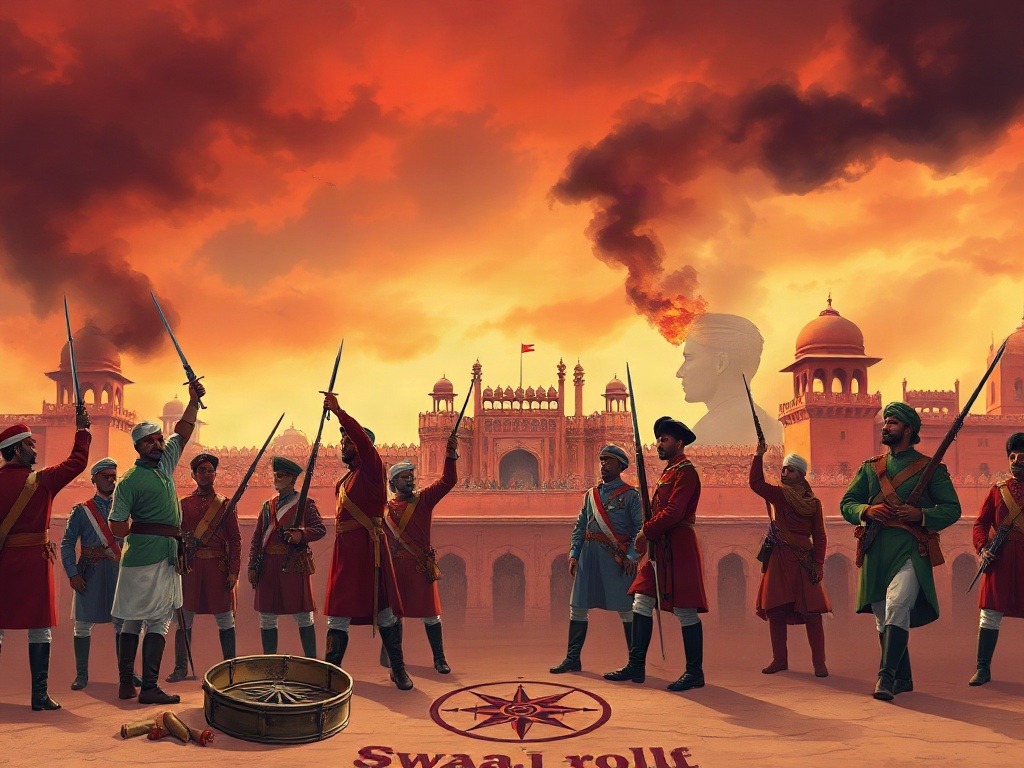
May 10, 1857. A date that should be on every Indian's tongue, but honestly, most people forget it by the time they leave school. Let me paint the picture for you.
How It Started and Spread
The rebellion began in Meerut when sepoys refused to use the controversial cartridges. Eighty-five of them were court-martialed, convicted, and imprisoned. Their fellow soldiers were furious. On May 10, they revolted, freed the imprisoned men, and marched toward Delhi. This wasn't a planned, centrally organized uprising—it was spontaneous, which actually made it more dangerous because it spread like wildfire.
In Delhi, they found Bahadur Shah Zafar and proclaimed him the Emperor of India again. Now, here's the brilliant part: by making it about restoring the Mughal Empire, the rebels united Hindu and Muslim soldiers under one banner. In Kanpur, under Nana Sahib, they massacred 200 British civilians and soldiers—an act of vengeance, but also one that hardened British resolve and turned the conflict into something very ugly and personal.
Let me give you a memory trick I use with all my students: MEERUT-DELHI-KANPUR = M-D-K: Movement → Declaration → Killing. The three stages that defined the initial momentum of the revolt.
Why It Failed (The Uncomfortable Truth)
By 1858, it was over. The British, under General Henry Havelock and General James Outram, systematically recaptured cities. Delhi fell in September 1857. Bahadur Shah Zafar was exiled to Burma. Nana Sahib fled. And within 14 months, the organized rebellion had been crushed.
Why? Several reasons, and this is crucial for your exam:
First, the rebels had no unified command. There was no national leadership, no clear strategy beyond local grievances. The peasantry participated in some areas but not others. The Hindu-Muslim unity, while real, was fragile and based on negative sentiment (anti-British) rather than positive vision (what kind of India?).
Second, many sections of Indian society didn't participate. The Sikhs, still angry about their recent defeats, actually sided with the British. Large sections of the peasantry in Bengal and Bombay Presidency didn't join. The landed elite, particularly in many areas, preferred the stability of British rule to the uncertainty of rebellion.
Third, the British were better organized, had superior firepower, and could communicate faster thanks to the telegraph network they'd built across India.
But here's what's critical: failure doesn't mean irrelevance.
The Aftermath: How 1857 Changed Everything
The British response to 1857 was brutal. Thousands were executed—some accounts say 100,000. Entire villages were razed. Bahadur Shah Zafar, the last symbol of Indian empire, died in exile. It seemed like the rebellion had failed completely. But here's where it gets interesting.
Administrative Changes
In 1858, the British formally dissolved the East India Company (which had been ruling India) and brought India under direct Crown control. Lord Canning became the first Viceroy. Now, this sounds like Britain simply consolidated power, but actually, the nature of that power changed subtly.
The British realized they couldn't rule India through exploitation and contempt alone. They needed legitimacy. So they made certain concessions: the introduction of civil service exams (which eventually led to Indians entering the ICS), gradual expansion of local governance through councils and legislatures, and a more careful approach to religious and cultural matters. Was this genuine reform or clever manipulation? Probably both. But the key point: 1857 forced Britain to negotiate with India in ways they hadn't before.
The Birth of Modern Indian Nationalism
Now here's the profound part. The 1857 rebels didn't have a vision of a modern Indian nation-state. But their rebellion created the conditions for such a vision to emerge. Educated Indians—many of them products of British education—started asking: if the British can be defeated (even if only temporarily), why can't we build a better system?
The Indian National Congress was founded in 1885, just 28 years after 1857. Its founders—people like A.O. Hume, Surendranath Banerjea, and Dadabhai Naoroji—were directly influenced by the memory of 1857. They chose a different path: constitutional agitation rather than armed rebellion. But they were responding to the same fundamental problem 1857 had highlighted—the injustice of colonial rule.
From 1857 to Independence: The Long Freedom Struggle
Once you understand 1857, the freedom struggle becomes a coherent narrative instead of random events. Let me trace the thread for you.
The Moderate Phase (1885-1905)
The Indian National Congress started with moderates like Dadabhai Naoroji, G. Surendranath Banerjea, and A.O. Hume. They believed in working within the British system—petitions, debates, constitutional reform. They achieved some real gains: the Vernacular Press Act was repealed, the Indian Council Act of 1892 expanded Indian participation in governance, and they successfully educated public opinion about the exploitation of India.
But here's the thing: they were too polite, too constitutional. Many younger Indians felt they weren't going fast enough. This led to the rise of the Extremists—Lala Lajpat Rai, Bal Gangadhar Tilak, and Bipin Chandra Pal—the famous "Lal-Bal-Pal" combination (my students love this mnemonic!).
The Extremist Challenge (1905-1920)
The Extremists—or the "Nationalists" as they preferred to be called—believed that Swaraj (self-rule) couldn't be begged for. It had to be snatched. They organized mass movements like the Swadeshi movement (boycott of British goods) and Swaraj movement. Bal Gangadhar Tilak famously said, "Swaraj is my birthright, and I shall have it."
Now, were some of them associated with revolutionary violence? Yes. Khudiram Bose, Surya Sen, Bhagat Singh—these names invoke a different kind of heroism than Gandhi. But here's a nuance most textbooks skip: even the revolutionaries, despite their methods, were responding to the same frustration that 1857 had symbolized—the refusal to accept colonial inferiority.
The Gandhian Phase (1920-1947)
Gandhi arrived on the scene in 1915, but his major role began after 1919 (Jallianwala Bagh massacre). He took the spirit of 1857—mass participation, defiance, refusal to cooperate with the colonial system—and combined it with a constitutional method that the British found impossible to repress militarily.
Non-violent Non-Cooperation (1920-22), Civil Disobedience (1930-34), and Quit India (1942) were mass movements that involved crores of Indians. They were effective not because they were gentle, but because they involved such massive numbers that the British couldn't arrest everyone or shoot everyone. It was 1857's lesson—that Indians could unite across regions and religions—married to a strategy that the British couldn't effectively counter.
And finally, in 1947, it was done. India was free.
| Phase | Years | Key Leaders | Method | Major Movement |
|---|---|---|---|---|
| Pre-Congress Awakening | 1800-1885 | Ram Mohan Roy, Keshab Chandra Sen | Social & Religious Reform | Brahmo Samaj |
| Moderate Phase | 1885-1905 | Dadabhai Naoroji, Surendranath | Constitutional Agitation | INC Petitions & Debates |
| Extremist Phase | 1905-1920 | Tilak, Lala Lajpat Rai, Aurobindo | Boycott, Mass Movement | Swadeshi & Swaraj |
| Gandhian Phase | 1920-1947 | Mahatma Gandhi, Nehru, Ambedkar | Non-Violent Mass Action | Quit India 1942 |
So when you're asked in your exam, "What was the significance of 1857?" or "How did 1857 shape the freedom struggle?" you now have a real answer. It wasn't just a failed rebellion. It was the first time modern India collectively rejected colonial rule, and that act of collective rejection set the tone for everything that came after. The methods changed. The leadership changed. But the fundamental refusal to accept British authority—that came from 1857.
That's why I always tell my students: master 1857, and the entire modern Indian history becomes connected narrative instead of disconnected facts. Good luck with your exams!
Published by Dattatray Dagale • 31 October 2026








0 Comments