Introduction
You know, when I first started teaching history, I realized that most of my students had this vague, fuzzy understanding of the Mughal Empire. They'd remember names like Akbar and Shah Jahan, maybe a fact or two about the Taj Mahal, and that was it. But here's what I learned over 10 years of teaching: the Mughal Empire isn't just a collection of facts to memorize. It's actually a fascinating story of ambition, cultural brilliance, and administrative genius that shaped everything we see in modern India today.
The Mughal Empire lasted for nearly 300 years—from 1526 to 1857. That's longer than most countries have existed! When you think about it, that's almost three centuries of influence on our art, our architecture, our food, our language, and even our governance systems. Walk into any major Indian city today, and you're surrounded by Mughal heritage—whether it's the Taj Mahal in Agra, the Red Fort in Delhi, or the Jama Masjid.
Now, before we dive deeper, let me be honest with you: Mughal history can feel intimidating at first. There are so many emperors, battles, policies, and cultural movements. But I promise you, if you approach it the way I'm going to teach it today, it'll stick with you forever. Think of the Mughal Empire like a cricket team's journey. You've got the founder Babar who started the team, then Akbar who made it unbeatable, then later emperors who let it slip away. Same story, right?
Foundation and Early Glory: Babar to Akbar
The Man Who Started It All: Babur (1526–1530)
Let me tell you something interesting. Babur wasn't actually supposed to conquer India. He was a Central Asian warrior—Turco-Mongol descent, to be precise—who was initially just trying to find a place to call home after being kicked out of his ancestral territories. India was almost like his backup plan, if you will.
But here's where it gets brilliant. In 1526, Babur defeated Ibrahim Lodi at the First Battle of Panipat. This wasn't just any battle—it was a turning point in Indian history. Ibrahim Lodi had a huge army, but Babur used something revolutionary: gunpowder artillery and tactical cavalry warfare. Imagine being an Indian emperor used to traditional sword-and-shield combat, and suddenly this guy shows up with cannons. You're already defeated before the real fighting starts.
What I love about Babur, and what you absolutely must remember, is that he was an intelligent administrator, not just a warrior. He established strong central authority, organized the empire into provinces called "subahs," and created a meritocratic system where people were promoted based on ability, not just their birth. This foundation was crucial for what came next.
Akbar the Great: The Empire's Golden Age (1556–1605)
Now here's the guy who truly made the Mughal Empire legendary. Akbar ascended the throne when he was just 14 years old, and under his guardian Bairam Khan's guidance, he became one of history's greatest rulers. Seriously, this man deserves all the hype.
Let me give you a trick I always tell my students to remember Akbar's achievements. It's called the "A-B-C-D" of Akbar:
- A = Administration: He reorganized the entire empire into a sophisticated bureaucratic system with clear hierarchies and efficient tax collection. The "mansabdari" system was his brainchild—it was a ranking system for military officers that was purely merit-based.
- B = Bhakti and Religious Tolerance: Akbar was genuinely interested in different religions. He married Hindu princesses, abolished the jizya (tax on non-Muslims), and even created a syncretic religion called "Din-i-Ilahi" to promote religious harmony. Now, not everyone approved of this, but his intention was clear: a unified empire.
- C = Culture and Learning: Akbar was an illiterate man—yes, you read that right—but he was obsessed with knowledge. He established the Mughal Court at Fatehpur Sikri and surrounded himself with brilliant minds. The "Navratna" or nine jewels of his court included Birbal, Abul Fazl, Faizi, and others.
- D = Decentralization with Control: While Akbar created a strong center, he also gave regional governors significant autonomy. This prevented rebellion because people felt heard, but the center remained ultimately powerful.
Here's something that will blow your mind: Akbar was illiterate, yet he was the most educated emperor in the sense that he had knowledge on every subject. His administration was so advanced that some historians argue it was a precursor to modern democratic governance. When you read about him in your exam, remember this contrast—it makes his story unforgettable.
The Era of Architectural Magnificence and Cultural Flourishing
Shah Jahan and the Taj Mahal (1628–1658)
You know what's funny? Every single student knows about the Taj Mahal, but very few understand why it's so important historically. It's not just beautiful—it's a statement about the emperor's power, wealth, and vision.
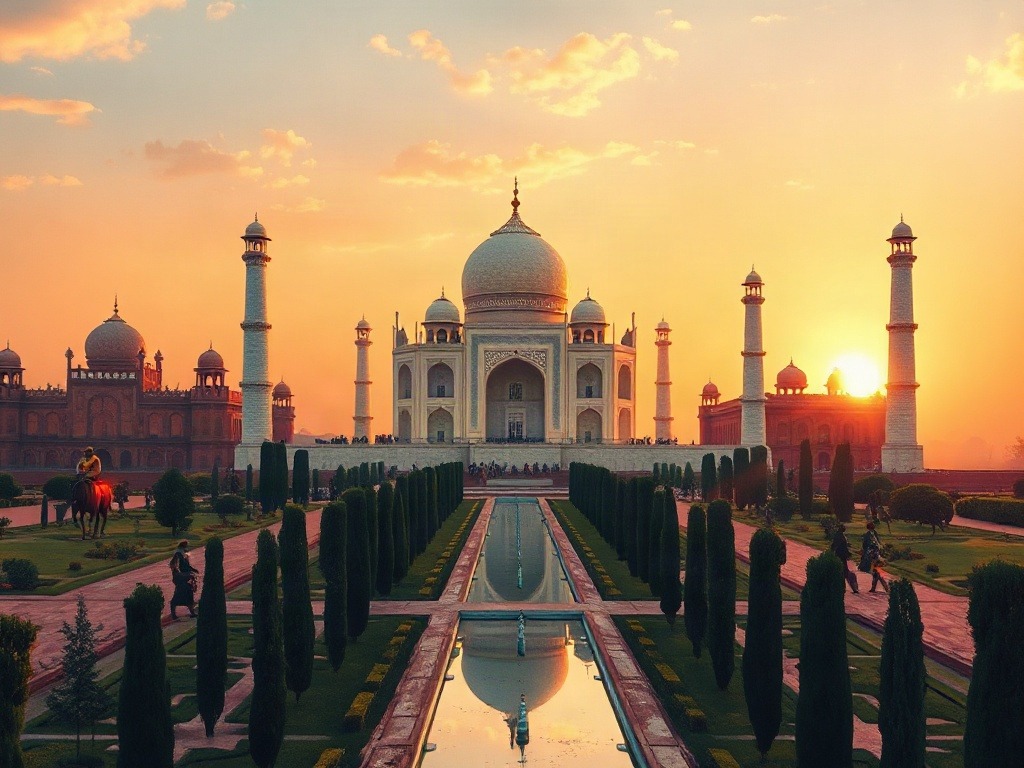
Shah Jahan was Akbar's great-grandson, and he inherited an empire that was already at its peak economically. But Shah Jahan took the artistic and architectural legacy to another level entirely. The Taj Mahal, built between 1632 and 1653, is actually a monument to his wife Mumtaz Mahal, who died during childbirth. The story itself is romantic, but the architecture? That's where the real genius lies.
Think about it this way: the Taj Mahal is a perfect synthesis of Persian, Islamic, and Indian architectural styles. The intricate marble inlay work, the symmetrical gardens, the calligraphy—every single element was designed with mathematical precision. The emperor spent approximately 20 million rupees on this structure, which would be equivalent to billions in today's money. And he built it knowing it would last forever and remind the world of his love and his power simultaneously.
But here's what most students miss: Shah Jahan's reign saw the empire at its absolute territorial peak. He expanded borders, consolidated power, and created a cultural environment where arts and architecture thrived like never before. The Red Fort in Delhi, the Jama Masjid, the Moti Masjid—all built during his time. The problem? All this extravagance came at a cost. The empire's treasury began to deplete, and military spending weakened.
The Aurangzeb Paradox (1658–1707)
Now, Aurangzeb is the emperor that divides historians like no one else. Some see him as a tyrant; others see him as a sincere Islamic ruler trying to preserve religious orthodoxy. The truth, as always, is more nuanced.
Aurangzeb ruled for nearly 50 years and actually expanded the empire to its largest territorial extent. Militarily and administratively, he was brilliant. He personally led military campaigns, implemented strict Islamic law, and was extremely disciplined in his approach to governance. Unlike Shah Jahan, he wasn't interested in lavish monuments—every rupee went into maintaining military strength and governance.
But—and this is a big but—his policies had severe consequences. His decision to reimpose the jizya, his efforts to impose Islamic orthodoxy, and his attacks on temples alienated Hindu populations and regional powers. The Marathas, under leaders like Shivaji, began to resist Mughal authority. The empire remained vast, but cracks were forming in the foundation.
Here's what I tell students: Aurangzeb was a powerful administrator, but he lacked Akbar's political wisdom. Akbar understood that ruling a diverse empire requires tolerance and inclusivity. Aurangzeb believed in uniform Islamic rule across diverse populations. The difference between these two philosophies shaped the future of the empire.
| Emperor | Period | Key Contribution | Major Challenge |
|---|---|---|---|
| Babur | 1526–1530 | Founded the empire; Panipat I victory | Consolidating diverse territories |
| Akbar | 1556–1605 | Mansabdari system; religious tolerance | Managing ambitious nobles |
| Shah Jahan | 1628–1658 | Taj Mahal; architectural splendor | Economic drain from building projects |
| Aurangzeb | 1658–1707 | Maximum territorial expansion | Religious policies; regional rebellions |
Economic System and Social Structure
You might be wondering: how did the Mughals actually run this massive empire? Money, my friend. Or more specifically, a really clever system of taxation and administration.
The Mughal economy was primarily agrarian. The empire extracted revenue from land cultivation, and this system was quite sophisticated. Under Akbar, a brilliant finance minister named Todar Mal created the "Zabti" system—a kind of standardized tax assessment based on land surveys and crop yields. Imagine it like this: the government would survey every piece of land, calculate its average yield, and then tax the farmer a fixed percentage. It was fair, predictable, and efficient.
The social structure was hierarchical but not entirely rigid. You had the emperor at the top, followed by the nobility (mansabdars), then the merchant class, farmers, and artisans. Unlike the feudal system in Europe, the Mughal system allowed social mobility through military service and administrative talent. If you were good at what you did, you could climb the ranks. This was genuinely progressive for the time period.
Now here's something crucial for your exam: the Mughals were not just rulers; they were patrons of culture. They supported poets, artists, musicians, and craftsmen. This created a cosmopolitan culture where Persian, Arabic, and Indian traditions merged seamlessly. The result? You get unique art forms, a beautiful blend of cuisines (that's why Mughlai food exists!), and a shared cultural language across the empire.
Decline and Legacy: Why Empires Fall and What Remains
Here's the tragic part of the story. After Aurangzeb's death in 1707, the empire began to crumble. The later emperors—and there were quite a few—were generally weak, indulgent, and ineffective. Regional governors started asserting independence. The Marathas grew stronger. The Afghans invaded repeatedly. And then, the Europeans arrived with superior military technology and a hunger for trade that gradually turned into colonial conquest.
By the time the British formally took over in 1858 (after the Revolt of 1857), the Mughal Empire was already a shadow of its former self. The last emperor, Bahadur Shah Zafar II, was exiled to Burma. The empire that had lasted nearly 300 years was gone.
But here's what's important: the Mughal legacy never left India. Let me give you another memory trick—"M-U-G-H-A-L Legacy":
- M = Music and Arts: Hindustani classical music as we know it today was heavily influenced by Mughal court culture. Raag, taal, and many instruments were refined during this period.
- U = Urban Development: Cities like Delhi, Agra, and Lahore were redesigned and beautified. Urban planning principles were introduced.
- G = Governance: Concepts of centralized administration, bureaucracy, and rule of law that the British later adapted from Mughal systems.
- H = Hybrid Culture: A unique blend of Persian, Islamic, and Indian traditions that created what we call Indo-Islamic culture.
- A = Architecture: The Taj Mahal, Red Fort, and dozens of other structures that are now UNESCO World Heritage sites.
- L = Language: Urdu language developed from a mixture of Persian, Arabic, and Hindi. Mughal courts also refined Persian and Arabic in Indian contexts.
When you walk through Old Delhi today, you're walking through Mughal history. The Jama Masjid's call to prayer echoes the same way it did 400 years ago. The intricate latticed screens (jali work) in historical buildings still use the same techniques. The way we write Urdu, the way we cook biryani, the way we construct our domes and arches—all Mughal influences.
For your exams, remember this: the Mughal Empire's significance isn't just in its military might or territorial extent. It's in how it fundamentally changed India's cultural, linguistic, and administrative landscape. It's in the monuments we cherish, the food we eat, the music we listen to, and even the way we think about governance.
The next time you see a piece of Mughal architecture or taste Mughlai food, you're experiencing centuries of history. And that, my friend, is what makes history truly alive.
Practice Questions
A) Babur B) Akbar C) Shah Jahan D) Aurangzeb
Answer: B) Akbar. This was one of his most significant policies aimed at religious harmony and inclusivity.
A) Rana Pratap B) Ibrahim Lodi C) Shivaji D) Krishna Deva Raya
Answer: B) Ibrahim Lodi. This victory established Mughal rule in North India.
A) Land taxation B) Military ranking based on merit C) Religious hierarchy D) Trade regulations
Answer: B) Military ranking based on merit. It was a revolutionary bureaucratic innovation that allowed social mobility.
A) His own glory B) His mother C) His wife Mumtaz Mahal D) His military victories
Answer: C) His wife Mumtaz Mahal. It remains one of the most iconic symbols of love and architectural brilliance in the world.
A) Babur B) Akbar C) Shah Jahan D) Aurangzeb
Answer: D) Aurangzeb. Despite his controversial policies, he militarily expanded the empire to its maximum boundaries.
Published by Dattatray Dagale • 05 October 2026







0 Comments