Introduction
Look, I'm going to be honest with you. When I started teaching SSC CGL ten years ago, I noticed something fascinating. Students could rattle off facts about alluvial soils or black soils like they were reciting cricket statistics. But ask them why a particular crop grows in a particular region, and you'd get blank stares.
That's because most of us study Indian agriculture like it's a random collection of facts to memorise. But here's the real magic — once you understand the connection between soil, climate, and crops, the entire topic becomes a living, breathing system. It stops being something you memorise for an exam and becomes something you *understand*.
I've had students tell me after the exam: "Sir, I didn't even have to fully memorise which crop grows where. Once I understood *why* it grows there, the answer just clicked." That's exactly what we're going for today.
The Soil Foundation: Understanding India's Five Major Soil Types
Before we talk crops, we need to talk soil. Because soil isn't just dirt — it's the playground where all of agriculture happens. Think of it like this: if crops were cricket players, soil would be the pitch. Change the pitch, and you change the entire game.
India has five major soil types, and I want you to forget the boring textbook definitions. Instead, let me tell you what each one actually *is*:
Alluvial Soils: The Gift of Rivers
Picture this — I once visited a farmer in Uttar Pradesh's Doab region (the land between the Ganga and Yamuna). He showed me his fields and said, "Sir, every monsoon, the river gives me a fresh coat of fertiliser." That's alluvial soil.
These soils are formed by river sediments — clay, silt, and sand deposited by flowing water. They're incredibly fertile, which is why about 46% of India's agricultural land is alluvial. You'll find them in the Indo-Gangetic Plain, the Brahmaputra Valley, and coastal plains. They're the reason the Gangetic plains are called the "grain bowl of India."
Here's something interesting: alluvial soils are perfect for wheat, rice, sugarcane, and cotton. Why? Because they're well-drained (the sand component ensures water doesn't stagnate), they're rich in nutrients (thanks to the silt), and they're easy to work with.
Black Soils: The Volcanic Legacy
Black soils are my personal favourite to teach because they have such a dramatic origin story. They were formed from basaltic lava flows thousands of years ago, especially in the Deccan Plateau. The iron and magnesium in the lava broke down over centuries to create these dark, fertile soils.
Now, here's a mnemonic I tell all my students for the properties of black soil: **"HCR"** — High water retention, Calcium-rich, and Rich in nutrients. These soils hold water like a sponge, which is brilliant during dry seasons but can become waterlogged in heavy rains. That's why farmers in Maharashtra and Karnataka often grow cotton — a crop that loves this soil but can handle the moisture fluctuations.
Black soil is found primarily in Maharashtra, Madhya Pradesh, Gujarat, and parts of Karnataka. It covers about 16% of India's agricultural area. The real treasure of black soil? It's naturally rich in iron oxide and alumina, which is why it's sometimes called "regur soil" in technical terms.
Red and Laterite Soils: Acidic Challenges
Red soils get their colour from iron oxide — basically, they're literally rusty. You'll find them in the Deccan Plateau, Tamil Nadu, and parts of Odisha. They're acidic and leached (meaning nutrients have been washed away by heavy rainfall), which makes them naturally less fertile than alluvial or black soils.
But here's where it gets interesting — laterite soils (which form in high-rainfall areas and are an extreme version of red soils) are poor for agriculture but excellent for bauxite mining. That's why you'll see mining operations in Western Ghats and Odisha. However, when amended with lime to reduce acidity, they can grow decent crops like groundnut, jowar, and tea.
Desert and Brown Soils: The Arid Fighters
Found in Rajasthan and parts of Gujarat, these soils are low in organic matter and moisture. They're sandy, well-drained, but poor in nitrogen and phosphorus. You might think nothing grows here, but farmers have learned to grow bajra (pearl millet) and groundnut because these crops have evolved to survive in such conditions.
How Climate, Soil and Crops Dance Together
Now here's the really interesting part. Understanding Indian crops isn't about rote memorisation — it's about understanding this simple equation:
Soil Type + Rainfall + Temperature + Topography = Crop Choice
Let me break this down with real examples that I use in my classes:
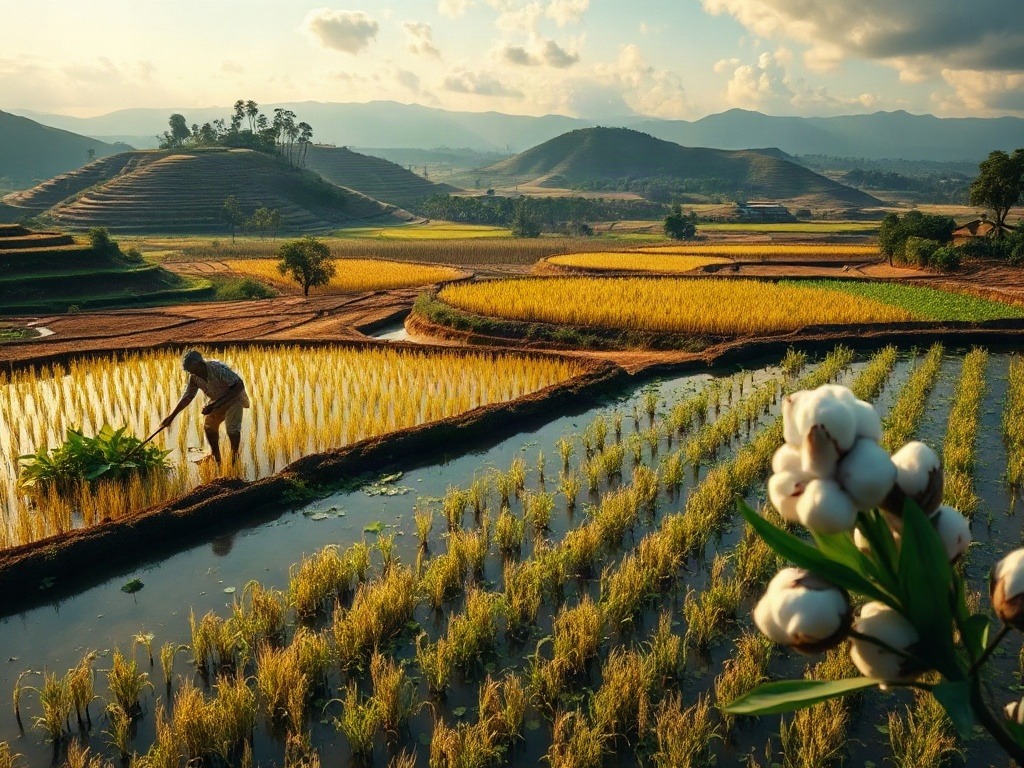
Rice in Bengal: Why does West Bengal produce so much rice? Because you have alluvial soils (from the Brahmaputra and other rivers), high rainfall during monsoon (150-250 cm), and flat terrain. Rice needs waterlogged conditions and these three factors deliver exactly that.
Cotton in Gujarat: Cotton grows beautifully in black soils of Gujarat because the soil retains water (cotton doesn't need flooding but needs consistent moisture), the region gets 40-60 cm of rainfall (not too much, not too little), and temperatures stay warm. Perfect cotton climate.
Coffee in Western Ghats: Coffee needs well-drained red soil, high rainfall (above 150 cm), shade from taller trees, and cooler hill temperatures. The Western Ghats deliver all of this. You couldn't grow coffee in Punjab even if you wanted to — completely wrong climate.
Major Crops and Their Geographic Home: The Real Story
Cereals: The Staple Foundation
Let me give you a trick for remembering India's cereal production. Remember: **"WBOR"** — Wheat from northern plains, rice from eastern and southern India, Oats and other cereals from hill stations.
Wheat dominates the Indo-Gangetic Plain because it loves alluvial soils and the rabi season (winter). Punjab, Haryana, and Uttar Pradesh are your major wheat states. The Green Revolution of the 1960s literally started here with high-yielding wheat varieties.
Rice is the monsoon crop of eastern India — West Bengal, Odisha, and Assam. It's also grown in parts of Tamil Nadu and Andhra Pradesh. Rice needs high rainfall, alluvial soils, and warm temperatures. The same plant that thrives in Bengal's 200 cm rainfall would struggle in Punjab's 50 cm.
Millets (jowar, bajra, ragi) are the forgotten heroes of Indian agriculture. They grow in marginal lands where other crops can't — dry areas of Rajasthan (bajra), parts of Maharashtra (jowar), and the Deccan Plateau (ragi). They're drought-resistant and don't need much. Honestly, they're tougher than most of us.
Cash Crops: The Farmer's Goldmine
Cash crops are different from cereals because farmers don't eat them — they sell them. So the logic is: grow where you have the perfect conditions and transportation to sell.
Cotton thrives in black soils of Gujarat, Maharashtra, and Punjab. Gujarat alone produces about 25% of India's cotton. Why? Black soil + moderate rainfall (50-100 cm) + warm climate = cotton heaven. This is why Ahmedabad became the Manchester of India.
Sugarcane is grown in Uttar Pradesh, Maharashtra, and Karnataka. It needs alluvial soils, high rainfall, and it's a water-intensive crop. A single sugarcane plant needs about 15-30 tonnes of water! That's why you see sugarcane in wetter regions and see it completely absent in Rajasthan.
Tea and Coffee are hill-station specialists. Tea in Darjeeling, Assam, and the Nilgiris; coffee in the Western Ghats. Both need shade, well-drained soil (red or laterite), high rainfall, and cool temperatures. You can't grow tea in Mumbai even with perfect irrigation because the heat is wrong.
Spices are scattered across India. Turmeric in Telangana and Maharashtra, cardamom in the Western Ghats, pepper in Kerala. Each has its own sweet spot.
Fruits and Vegetables: Niche Geography
Apples in Himachal Pradesh and Kashmir. Bananas in Gujarat and Tamil Nadu. Mango orchards across the country but especially in Uttar Pradesh. Each has chosen its region based on climate and soil. A mango farmer in Kashmir? That would be a disaster — mangoes need heat.
| Soil Type | Main Locations | Best Crops | % of Agricultural Land |
|---|---|---|---|
| Alluvial | Indo-Gangetic Plains, Brahmaputra Valley | Wheat, Rice, Sugarcane, Cotton | 46% |
| Black | Deccan Plateau (Gujarat, Maharashtra, MP) | Cotton, Sugarcane, Jowar | 16% |
| Red & Laterite | South India, Eastern Plateau (Tamil Nadu, Odisha) | Groundnut, Tea, Coffee, Ragi | 18% |
| Desert/Brown | Rajasthan, Parts of Gujarat | Bajra, Groundnut, Dates | 7% |
| Mountain | Himalayan Region | Apples, Temperate Fruits, Tea | 13% |
Agricultural Zones: India's Regional Farming Identity
India's agriculture isn't uniform across states. We have distinct agricultural zones, each with its own personality. Understanding these zones is crucial for any geography exam.
The **Northern Zone** (Punjab, Haryana, Himachal Pradesh) is the wheat-producing belt. The Green Revolution happened here, and it remains India's breadbasket. High technology adoption, good irrigation infrastructure, and suitable climate make this the most productive region per hectare.
The **Eastern Zone** (West Bengal, Bihar, Odisha, Assam) is rice territory. High rainfall, alluvial soils, and flat terrain make rice the natural choice. This region feeds a huge population but remains somewhat less mechanised than the north.
The **Southern Zone** (Tamil Nadu, Andhra Pradesh, Telangana, Karnataka) is incredibly diverse. You get rice in coastal areas, sugarcane where there's irrigation, coffee in hills, spices in the ghats. It's like India's agricultural palette all in one region.
The **Western Zone** (Gujarat, Maharashtra, Rajasthan) is where cotton, groundnut, and millet reign. Gujarat is an agricultural innovation hub — you'll see everything from drip irrigation to hi-tech farming here.
The **Central Zone** (Madhya Pradesh) is primarily grain-producing — wheat, soybean, and gram. It's not as famous as Punjab, but it produces a massive amount of India's food.
Here's something I always tell my students: if you understand these five zones and their natural crops, you've literally cracked half the agricultural questions that come in exams. Because 90% of the time, a question is just asking you whether you know which crop grows in which zone.
Modern Agricultural Challenges and Regional Variations
Now, one thing I want you to understand is that Indian agriculture isn't static. It's facing real challenges, and these challenges vary by region.
In Punjab and Haryana, excessive groundwater extraction for irrigation has depleted water tables. Farmers who conquered water scarcity 50 years ago are now facing it again. Some are shifting to crops that need less water, but it's slow.
In eastern India, despite high rainfall, productivity remains lower due to fragmented landholding, poor irrigation infrastructure, and traditional farming methods.
In the South, shifting to commercial crops (cotton, sugarcane) has sometimes compromised food grain production. Climate variability is making traditional cropping patterns less predictable.
These aren't just facts for exams — they're real problems affecting real farmers. Understanding them gives you perspective on why Indian agriculture is the way it is.
That's also why you need to know not just "what grows where" but "why" and "under what stress." Your UPSC interview, if you make it that far, will definitely ask you about agricultural challenges and solutions. And trust me, when you can speak from understanding rather than memorisation, it shows.
A) Black soil B) Alluvial soil C) Red soil D) Desert soil
Answer: B) Alluvial soil (approximately 46% of India's agricultural area)
A) Eastern Zone B) Southern Zone C) Northern Zone D) Western Zone
Answer: C) Northern Zone (Punjab, Haryana, Uttar Pradesh) – The Green Revolution of 1960s started here with wheat production
A) Indo-Gangetic Plains B) Deccan Plateau C) Western Ghats D) Coastal Plains
Answer: B) Deccan Plateau (Formed from basaltic lava flows, found in Maharashtra, Gujarat, Madhya Pradesh)
A) Formed by river sediments B) High water retention capacity C) Rich in iron oxide D) Suitable for wheat cultivation
Answer: C) Rich in iron oxide (This is a characteristic of red soil, not alluvial soil. Alluvial soil is formed from clay, silt, and sand deposits)
A) Nilgiris B) Western Ghats C) Eastern Himalayas D) Deccan Plateau
Answer: B) Western Ghats (Coffee requires well-drained laterite soil, high rainfall, shade, and cool hill temperatures – conditions perfectly met in Western Ghats regions of Karnataka and Kerala)
Published by Dattatray Dagale • 04 September 2026
.jpg)
.png)



.png)


.png)


0 Comments